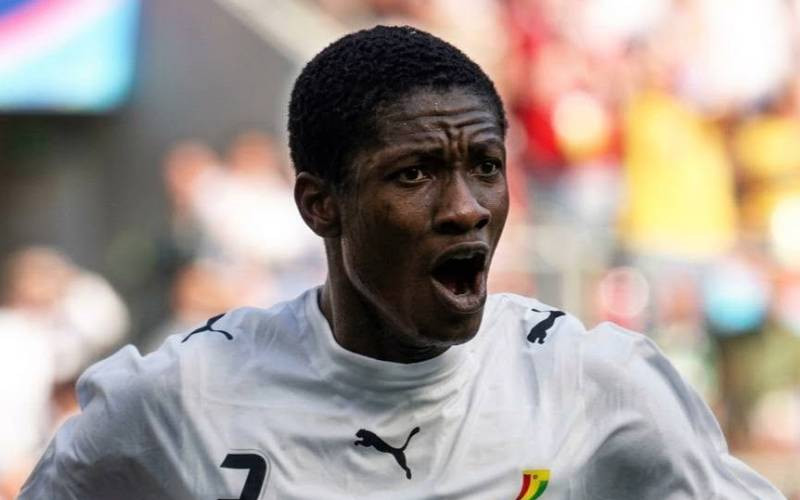
Asamoah Gyan walked into Nyayo National Stadium on Sunday and said out loud what many Kenyans already know but rarely hear from someone of his stature. Kenya, he argued, has chosen the wrong game to invest in — and an entire generation of footballers is paying the price for that choice.
Speaking during the finals of the Captain Irene Ndanu Super Cup and Soccer Summit, the Ghanaian legend did not come to flatter his hosts. He came with a diagnosis. “Kenya lacks the basics,” he said plainly, drawing a direct comparison with Ghana’s football infrastructure and pointing to athletics as the cultural and institutional priority that has long overshadowed the beautiful game in this country. That observation, delivered by a man who played in four FIFA World Cups and captained one of Africa’s most formidable footballing nations, deserves more than a polite nod — it demands a serious reckoning.
The Foundation That Was Never Built
Gyan’s argument is not complicated, and that is precisely what makes it so damning. Football, at every level of global competition, is built from the bottom up — from dusty pitches in neighbourhood estates, from patient coaches drilling seven-year-olds on how to trap a ball, from academies that exist not to generate profit but to produce players. Ghana understood this. Kenya, by and large, did not. The grassroots infrastructure that should serve as the pipeline feeding talent into professional clubs and national teams remains fragile, underfunded, and in many parts of the country, entirely absent. Gyan himself started on the streets of Ghana before earning a move to Europe, and he is acutely aware of what happens when that street-level talent finds no ladder to climb — it disappears. “When they don’t get support, they give up,” he said, and those five words carry the weight of thousands of Kenyan careers that never happened.
What makes this particularly frustrating is that the talent is self-evidently there. No one who has watched football in Nairobi’s informal settlements, or followed the Chapa Dimba na Safaricom grassroots tournaments that briefly lit up the country’s imagination, can honestly argue otherwise. Kenya produces athletic, technically gifted young players in abundance. The problem is not the raw material — it is the system, or rather the absence of one, that is supposed to refine it. Gyan’s call for stronger pathways linking grassroots competitions with academies and professional clubs is not a radical idea; it is the most basic requirement of any functioning football ecosystem, and Kenya has yet to build it in any coherent, sustained way.
The Bigger Picture Kenya Cannot Afford to Ignore
The timing of Gyan’s remarks is not incidental. Kenya is set to co-host the 2027 Africa Cup of Nations, and Harambee Stars are navigating 2026 FIFA World Cup qualifiers under South African coach Benni McCarthy, who has brought some visible improvement in recent performances. The Harambee Starlets, meanwhile, secured qualification for the 2026 Women’s Africa Cup of Nations with a commanding 4-1 aggregate win over The Gambia — before suffering a sobering 4-0 opening defeat to Morocco, a result that illustrated precisely the gap between qualifying and competing at the continental level. These are not isolated results; they are symptoms of the structural deficit Gyan identified. You can qualify on effort and individual brilliance, but you cannot consistently compete against nations that have spent decades investing in player development, coaching education, and professional league standards.
The 2027 AFCON co-hosting opportunity is enormous, and Kenya’s political and sports establishment will spend considerable energy ensuring the stadiums are ready and the hospitality is world-class. That is the easy part. The harder, more consequential work — building the grassroots foundation that produces players capable of competing in those stadiums — requires a commitment that extends far beyond a single tournament cycle, one that demands sustained investment, institutional accountability, and a genuine shift in how this country prioritises football relative to other sporting disciplines. Gyan also made a point of emphasising that education must remain central to any young player’s journey, a reminder that developing human beings and developing footballers are not competing goals but complementary ones. Kenya’s young, talented, and increasingly impatient football generation deserves both — and they deserve a system that stops making them choose.