People are dying. Not on a battlefield, not from a disease with a complicated name — they are dying in Kiambu and Kirinyaga because someone, somewhere, mixed chemicals in a backroom and sold the result as alcohol. Deputy President Kithure Kindiki stood in Limuru on Friday and said, plainly, that this ends now.
“Your days are numbered. We are coming for you.” Those were not the words of a politician reading from a prepared script. That was a man who spent years as Interior Cabinet Secretary coordinating operations against Al-Shabaab in Lamu and armed bandits in Northern Kenya, and who now appears to have found his next target closer to home.
Think about what that comparison actually means. The government deployed security forces, intelligence assets and sustained political will to push back some of East Africa’s most dangerous armed groups — and Kindiki is now drawing a direct line between that fight and the war on illicit brew. He is not hedging. He is not saying “we will look into it.” He is saying the same machinery that broke terrorist networks will be turned on men who sell poison in plastic bottles.
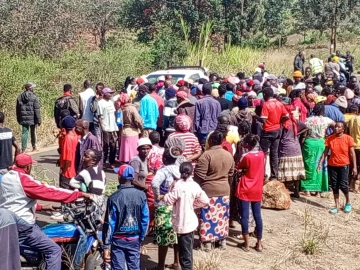
The numbers behind this crisis are not abstract. People in Kiambu have died recently. People in Kirinyaga died before them. These are not statistics buried in a health ministry report — they are someone’s father, someone’s brother, someone’s friend who went out for a drink and did not come back. The DP acknowledged this directly, invoking the pain of Mt. Kenya elders who had specifically requested his intervention. This is personal, and Kindiki made sure everyone in that room understood it.
What makes this moment different from the usual government posturing is the operational specificity. Kindiki announced that orders have already been issued for the inspection of all alcohol manufacturing premises, with compliance checks against quality and public health standards before any product reaches the market. That is a structural intervention, not a press conference promise. The distinction matters.
He was equally blunt about the most dangerous players in this ecosystem — the ones who do not even bother with premises. “Some do not even have premises. They just mix chemicals and sell to Kenyans.” No building, no license, no accountability, no consequence. Until now, apparently.
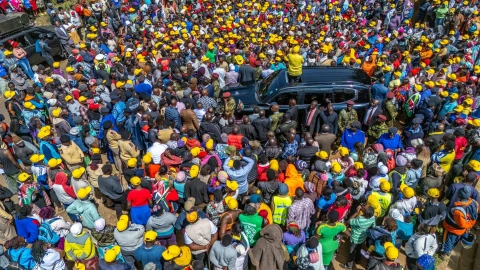
The Limuru event itself was ostensibly about dairy farming — Kindiki flagged off nine milk coolers headed to cooperative societies across Kiambu, part of a broader national distribution of 227 coolers bought to reduce wastage and boost farmer incomes. Kiambu alone has received 13 coolers worth Ksh. 98.14 million, with projections suggesting over 21,500 dairy farmers will benefit and 15.7 million litres of milk saved from annual wastage, translating to 769 million shillings that would otherwise have been lost. Kenya, the DP noted, is now the largest producer of processed milk in Africa. That is a real achievement and it deserved its moment.
But the alcohol warning overshadowed everything else, because it had to. You cannot talk about building prosperity for Kenyan communities while people in those same communities are being quietly killed by what they drink.
Kindiki also took time to address the political temperature in the Mt. Kenya region, warning residents against being drawn into incitement and inter-community conflict driven by political rivalries. “Incitement and violence are not politics,” he said. “It is criminal and unacceptable.” He framed unity not as a platitude but as a practical necessity — a community fracturing along political lines is a community that cannot hold its leaders accountable for anything, including the quality of the alcohol being sold on its streets.
The question that smart, skeptical Kenyans should be asking right now is not whether Kindiki means what he says — his track record on security operations suggests he does — but whether the institutions beneath him are capable of following through. Inspections can be announced and then quietly shelved. Crackdowns can be launched and then fade after the cameras leave. The illicit brew trade has survived many government warnings before this one.
What is different this time, if anything, is the personal and political weight Kindiki is putting behind the pledge. He tied it to the grief of elders. He tied it to his own record. He tied it to the same resolve that dismantled armed networks in the north. Whether that resolve survives the bureaucratic grind of actual enforcement is the real story — and that story is still being written.
For now, somewhere out there, someone is mixing chemicals in a room with no license and no oversight. Kindiki says he is coming. The people of Kiambu and Kirinyaga are watching to see if he means it.