Joburg Is Drowning in Debt and Broken Pipes — And Your Mayor Just Gave a Speech About It
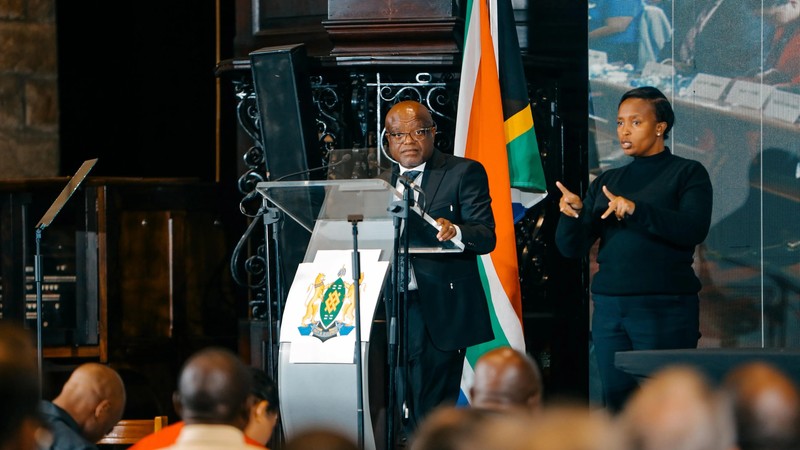
On Wednesday, 20 May 2026, Johannesburg Mayor Dada Morero stood inside St Mary’s Anglican Cathedral and told the city’s residents what they already know in their bones: Johannesburg is broken. What he didn’t do was convince anyone that he’s the man to fix it.
The Numbers Don’t Lie — But They Don’t Comfort Either
Morero delivered his State of the City Address (SOCA) against a backdrop of cascading crises. The city owes Eskom R5.2 billion. Its infrastructure backlog has ballooned past R220 billion. Nearly half of Joburg’s water — 44.7% — is lost before it reaches a single tap. Electricity losses sit at 27.1%.
These aren’t abstract figures. This is the reason your street floods when it rains, your lights flicker without warning, and your refuse hasn’t been collected in weeks.
The Blame Game Is Getting Old
Morero’s go-to defence? Blame the DA. He insisted the ANC-led coalition inherited a “broke city” from the Democratic Alliance — not once, but twice: in 2019 and again in 2023.
“In 2019, we inherited a broke city. Fact, not fiction,” he said. But here’s the uncomfortable truth: the ANC has been running Joburg for years now. At some point, the mess becomes yours.
What He’s Promising
To his credit, Morero didn’t show up empty-handed. He outlined a set of concrete financial moves his administration is making:
He also called on the National Treasury, the Public Protector, and the Special Investigating Unit to probe the city’s finances — a move that reads less like confidence and more like a man trying to share the burden of accountability.
Civil Society Isn’t Buying It
The ink on Morero’s speech was barely dry before civil society pushed back — hard.
JoburgCAN managing director Julia Fish cut straight to the point: “If the mayor’s optimistic picture of Johannesburg is accurate, then why are only around 60% of residents satisfied with service delivery?”
Fish didn’t stop there. When Morero claimed that 99.3% of residents receive water, JoburgCAN called the statistic meaningless. “That figure is meaningless unless the city explains what kind of access residents have,” she said. Receiving water on paper and having water in your tap are very different things.
OUTA’s executive manager Julius Kleynhans was equally blunt: “Residents living through collapsing infrastructure, water outages, refuse failures, billing chaos and deteriorating roads are unlikely to recognise the picture presented in this address.”
The Eskom Sword Hanging Over Joburg
The R5.2 billion Eskom debt isn’t just a financial problem — it’s an existential threat. If Eskom follows through on its notices to municipalities, Joburg residents could face power cuts that make load shedding look manageable.
Morero acknowledged the gravity of the situation but leaned on collective responsibility. “This challenge is not only affecting the City of Johannesburg but several municipalities across the country,” he said. True — but cold comfort when you’re the one sitting in the dark.
The Bottom Line
Morero closed his address with defiant optimism: “We have not collapsed, and it means we are doing something right.” But surviving is not the same as thriving. And for millions of Joburg residents — young people trying to build lives in a city that can’t keep the lights on or the water running — the bar has never been lower.
The real question isn’t whether Johannesburg has collapsed. It’s whether anyone in charge has a plan bold enough to stop it from getting there.