South Africa and India Are Building a $20 Billion Partnership — Here’s What’s Actually at Stake for Africa’s Youth
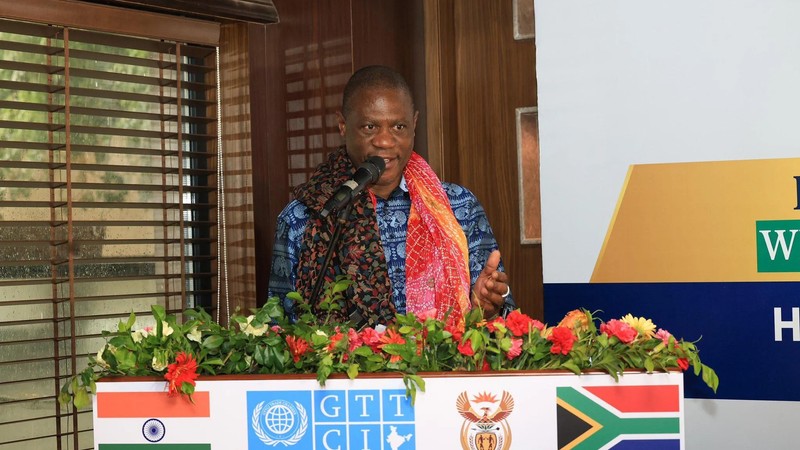
South African Deputy President Paul Mashatile landed in New Delhi on Friday, 29 May 2026, leading a high-powered delegation on a mission that goes far beyond diplomatic pleasantries. This is about money, technology, jobs — and who controls Africa’s economic future.
The Delegation Means Business
Mashatile didn’t travel alone. He brought the Minister of Health, the Minister of Small Business Development, and deputy ministers covering international relations, science and technology, and digital communications. When a country sends that many cabinet members on one trip, the agenda is serious.
He met India’s Vice President C.P. Radhakrishnan and paid a courtesy call on President Droupadi Murmu. These aren’t photo opportunities — they are the kind of access that unlocks investment pipelines and fast-tracks bilateral agreements.
The Numbers Don’t Lie
Trade between South Africa and India has exploded — from $4 billion in 2005 to nearly $20 billion in 2024. That is a fivefold increase in less than two decades. Something is clearly working between these two nations, and both sides want more of it.
The two countries already collaborate on the Square Kilometre Array — the world’s largest radio telescope — with South Africa leading and India as a key partner. This isn’t soft diplomacy. This is hard science and serious infrastructure.
What They’re Actually Negotiating
Mashatile was direct about where the opportunities lie. The South African government is actively courting Indian investment in:
That last point matters enormously. For generations, Africa has watched its minerals leave the continent unprocessed, with the value-added manufacturing happening elsewhere. Mashatile is explicitly pushing for manufacturing-focused investment — not extraction deals that leave communities with nothing but holes in the ground.
This Is About the Global South Fighting Back
Both South Africa and India are active in BRICS, the Non-Aligned Movement, IBSA, and IORA. Mashatile named it plainly — there are rising “unipolar forces” prioritising self-interest over international law and the needs of smaller nations. That is diplomatic language for a world where powerful countries write rules that benefit themselves.
The South Africa–India partnership is, at its core, a bet that the Global South can build its own rules, its own trade networks, and its own future — without waiting for permission from Washington or Brussels.
Where Young People Come In
Mashatile specifically flagged renewable energy, business process outsourcing, IT-enabled services and agro-processing as sectors with the strongest potential to create jobs for young people. Africa has the youngest population on the planet. India has one of the world’s most sophisticated tech workforces. The combination, if executed properly, could be transformative.
The India–South Africa CEOs Forum and the Joint Ministerial Commission are already creating openings for MSMEs and entrepreneurs — not just multinational corporations. That is a detail worth watching.
The Hard Question Nobody Is Asking
Deals like this are announced with fanfare and forgotten in implementation. South Africa’s InvestSA One Stop Shop has been promoted for years — the question is whether Indian investors will actually move capital, or whether this remains a series of elegant roundtable speeches.
Mashatile closed his address at the South Africa–India Technology, Trade, and Investment Roundtable with a Tshivenda proverb: “kule ndi husina wau” — there is no place too far as long as you have family. He called India family.
Family relationships, however, are only as strong as the commitments that follow the words. Africa’s young people will be watching to see whether this partnership delivers factories, fibre cables, and pharmaceutical plants — or just another communiqué gathering dust in a government archive.