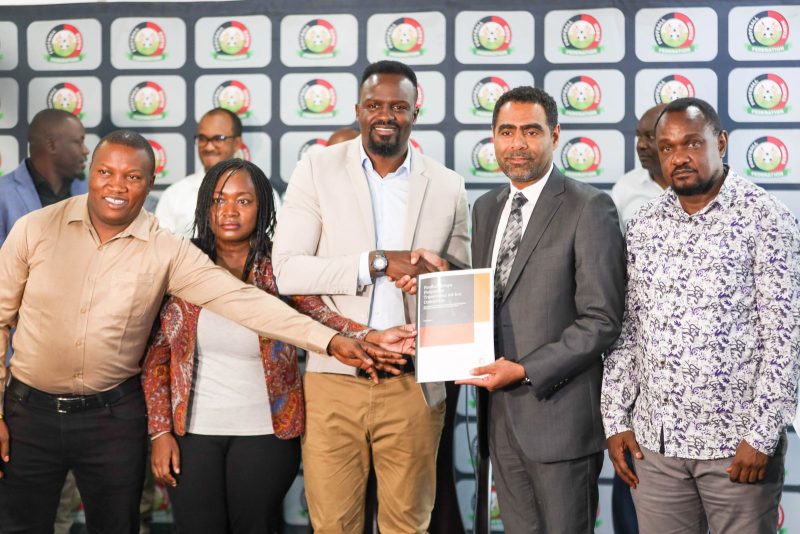
Picture this: two men who are supposed to be running Kenyan football are so deep in a power struggle that the national executive committee hasn’t been able to sit down and do its job properly in months. Now, with a single letter signed by FKF president Hussein Mohammed, a November 8 NEC meeting has been called at Weston Hotel — and what’s on that agenda should make every football-loving Kenyan sit up straight.
Seventeen items. Seventeen. Among them, a proposal to suspend an unnamed NEC member, compliance with a court order regarding acting CEO Dennis Gicheru, and — perhaps most telling of all — the matter of a Special General Meeting (SGM) scheduled the very day before in Meru. That SGM is where Hussein and his deputy MacDonald Mariga will be dragged before the FKF congress to answer for how they’ve been running, or rather misrunning, Kenyan football. If the congress finds them guilty, either one or both of them could be shown the door. The NEC meeting the next morning then becomes something else entirely — a room full of people who may have just watched their bosses get fired, deciding what to do next.
This is not bureaucratic noise. This is your federation, the body that controls how Kenyan football is funded, coached, and governed, tearing itself apart in public.
The rift between Hussein and Mariga has been building for a while, but it cracked open fully this month. Hussein accused Mariga and six other NEC members of refusing to find common ground on critical federation issues. Mariga fired back, claiming he has been deliberately sidelined from FKF operations. Two men at the top of the same organisation, both claiming the other is the problem, while Kenyan football sits in the middle taking the hits.
And the hits have been real. Harambee Stars coach Benni McCarthy went public with complaints that neither he nor his foreign technical staff have valid work permits, and that their allowances have been delayed. This is the man tasked with taking Kenya to the 2027 Africa Cup of Nations, operating without basic administrative support. Stars drew 1-1 with Eritrea in Nairobi, then lost 1-0 to Guinea in Conakry — results that reflect exactly the kind of instability that festers when leadership is distracted by internal warfare.
The women’s side tells an even bleaker story. Harambee Starlets lost every single match at the Women’s Africa Cup of Nations (Wafcon) in Morocco, and head coach Beldine Odemba paid for it with her job. She has since been replaced on an interim basis by Godfrey ‘Solo’ Oduor, formerly of Nairobi United — a stopgap solution that signals just how reactive, rather than strategic, FKF’s decision-making has become.
The NEC meeting on November 8 is supposed to address all of this. Coaching structures, legal compliance, internal discipline. But here’s the uncomfortable truth: how can a committee that has struggled to even convene, led by officials who may be voted out the day before, make credible decisions about the future of Kenyan football?
The answer, if you’re paying attention, is that it probably can’t. Not in its current state. What happens in Meru on November 7 will set the tone for everything that follows, and young Kenyans who care about seeing this country compete at the highest level of African football deserve to know that the people at Kandanda House are playing politics while the game suffers. Watch this space.