
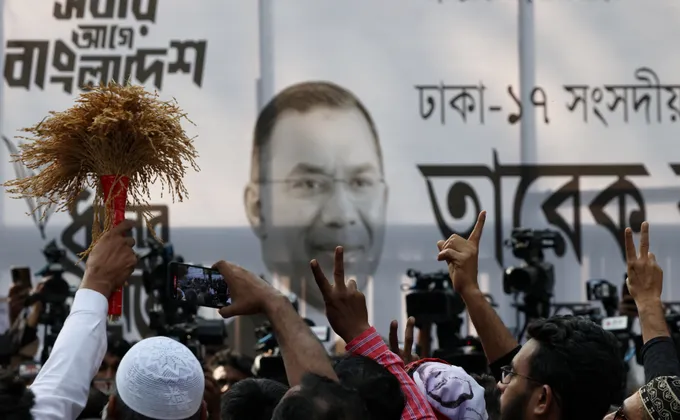
Tarique Rahman is on course to become Bangladesh’s next prime minister after his Bangladesh Nationalist Party (BNP) won enough seats to secure a parliamentary majority in the general election.
The result positions the 60-year-old BNP leader at the top of government after years spent outside the country and long-running legal and political battles.
Tarique Rahman returns to frontline politics after years in exile
Rahman belongs to the influential Zia political family. His mother, Khaleda Zia, served as prime minister in the 1990s and 2000s. His father, Ziaur Rahman, was a military ruler turned president who later founded the BNP.
However, his rise has also drawn repeated accusations of dynastic politics from opponents. Critics have long described his ascent inside the party as nepotism. Still, BNP figures have defended his position as central to the party’s organisation.
A rapid shift in BNP leadership before the vote
Rahman became active in BNP politics in 2001. He then moved into a senior party role in 2002, which increased his influence in decision-making.
In recent years, he ran party strategy while living in London. He served as acting chairman after his mother went to prison in 2018.
He returned to Bangladesh on December 25, 2025. Five days later, Khaleda Zia died. On January 9, Rahman formally took over leadership of the BNP.
Corruption and violence cases shaped his political image
Rahman has faced allegations of corruption and abuse of power for years. He has denied wrongdoing and has described the cases as politically driven.
He was arrested during a military-backed caretaker period in 2007. He later said authorities tortured him while he awaited trial. He spent about 18 months in prison before release.
After leaving Bangladesh, he remained away for roughly 17 years. Meanwhile, courts convicted him in absentia in several cases during the rule of former prime minister Sheikh Hasina.
Bangladesh’s courts later overturned key convictions, including in a major 2004 grenade attack case. That legal reversal removed one of the most serious barriers to his return to active politics.
New leadership brings scrutiny of governance plans
Supporters say Rahman’s long time in opposition gives him a mandate to rebuild institutions and restore stability. At the same time, critics say he must show he can move beyond party control tactics and lead a divided country.
Rahman now faces the task of turning an election majority into a functioning government, while managing demands for accountability, security, and economic direction.