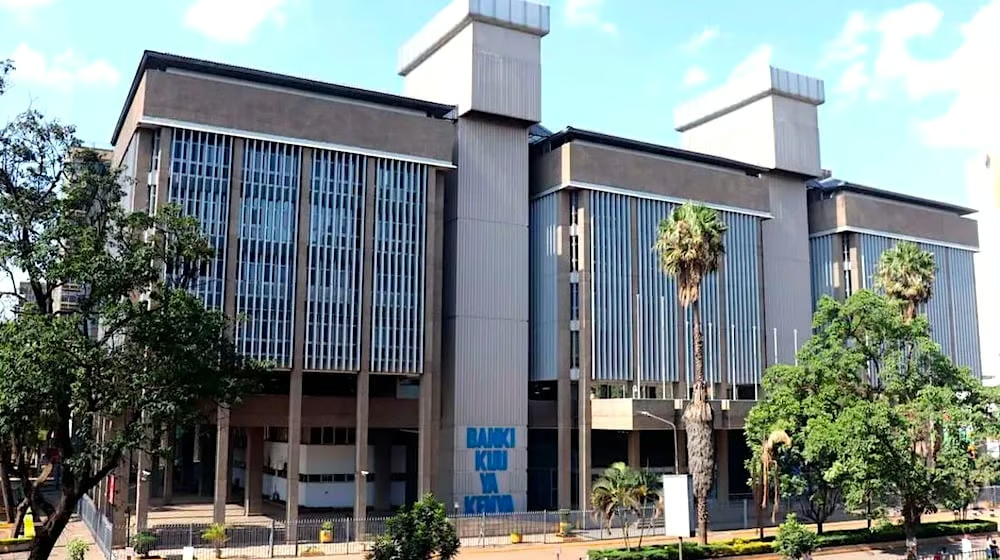
Global Markets Are Bleeding — And Kenya Is Not Immune
Wall Street sneezed, and the entire world caught a cold. A brutal sell-off in technology and AI stocks last week wiped billions off global markets, triggered a meltdown in South Korea, rattled Tokyo, and sent shockwaves through emerging economies — including ours. If you think this is a rich country problem, think again.
The crash started with the stocks you know: Nvidia, Samsung, the companies behind the chips powering the AI boom everyone has been breathlessly celebrating. When those valuations cracked, markets from New York to Nairobi felt it.
The Numbers That Should Wake You Up
South Korea’s Kospi index collapsed 10% in a single day, so violently that regulators triggered a 20-minute emergency halt — a so-called circuit breaker — to stop the bleeding. SK Hynix and Samsung, two chipmaking giants that together account for roughly half of South Korea’s entire stock market value, each lost more than 12% in hours.
On Wall Street, the S&P 500 dropped 1.4%, the tech-heavy Nasdaq fell 2.2%, and Nvidia shed 4%. Micron Technology — a major memory chipmaker — cratered 13.2% in one session. These are not abstract figures. These are the companies embedded in your pension funds, your mobile money infrastructure, and the devices in your pocket.
Asia Blinked — But Did Not Break
By Wednesday morning, markets began clawing back. South Korea’s Kospi bounced 3%, and Samsung surged 7%, signalling that Tuesday’s carnage may have been a panic-driven overcorrection rather than a structural collapse. Tokyo’s Nikkei 225 steadied after losing 1.1%, following a 3.6% drop the previous day.
Hong Kong’s Hang Seng edged up a modest 0.1%. Taiwan’s Taiex, deeply tied to semiconductor stocks, fell 2.5%. The recovery is real — but fragile.
What Is Actually Driving This?
Do not let anyone tell you this is just market noise. Two forces are colliding at once, and both matter for Kenya’s economic future.
Mason Mendez, global real assets analyst at Wells Fargo Investment Institute, put it plainly: “AI and valuations for tech-related companies are returning to the spotlight, as equity markets shift their focus from the Middle East war towards the sustainability of tech-related spending amid rising global interest rates.”
James Reilly, senior markets economist at Capital Economics, went further: “These big moves are part of a growing trend of rising volatility in tech stocks generally. This volatility is, in our view, evidence of excessive froth and calls into question the sustainability of this rally.” Translation: the AI hype bubble may be leaking air.
Where Does Kenya Sit in All This?
The South African rand held its ground despite the global turbulence — a small but telling sign that emerging market currencies can resist, not just absorb, external shocks. Kenya’s shilling has had its own brutal year. A global tech-driven downturn tightens dollar liquidity, raises the cost of external borrowing, and pressures currencies like ours.
Kenya’s government is already servicing a debt load that consumes more than half of revenue. If global investors pull money out of emerging markets — which they do, fast, when fear takes over — the cost of that debt gets worse. Your taxes pay for that. You feel that.
The Bottom Line
The AI gold rush was always going to face a reckoning. The question was never if — it was when, and who pays. Right now, the bill is being sent to ordinary people across the globe, from Seoul to Nairobi, who had no seat at the table when the bets were placed.
Watch this space. The recovery signals from Asia are real, but the underlying volatility is not going away. Stay informed, stay skeptical, and understand that what happens on Wall Street does not stay on Wall Street.