
Picture this: a president wrapping up an eight-day tour of the Coast, standing before a crowd of politicians who are supposed to be on his team, and telling them — with barely concealed urgency — to stop fighting each other. That is exactly where William Ruto found himself last week, and the optics alone should tell you everything about the state of his broad-based government.
The ODM-UDA coalition that Ruto has been carefully assembling as his 2027 re-election vehicle is fracturing at the seams, and the Coast is where the cracks are most visible. Kwale, Mombasa, Kilifi — county by county, the alliance is bleeding politicians who feel cheated, sidelined and handed over to decisions made in Nairobi boardrooms rather than at the ballot box.
Ruto’s message to the warring factions was blunt: “ODM and UDA are one team, and you should accommodate each other under a broad-based government. We should not allow divisions in ODM and UDA to undermine our unity of purpose.” Fine words. But they landed against a backdrop of genuine political fury that no speech can easily paper over, because the source of that fury is Ruto’s own strategy.
The president’s earlier attempt to zone the Coast — essentially pre-selecting which party gets which seat before a single vote is cast — is what lit the fuse. In Mombasa, UDA secretary general Hassan Omar has flatly rejected any arrangement that hands the governorship to incumbent Abdulswamad Nassir. Omar, also an EALA member, says he is running regardless. He is not bluffing.
Then there is Suleiman Shahbal, a businessman and fellow EALA member who read the writing on the wall inside ODM and simply walked out. He has since aligned with former Laikipia governor Murithi Nderitu’s Kenya Reform Party, making clear he intends to be on the ballot whether the coalition likes it or not. These are not fringe actors throwing tantrums — these are serious political players with real constituencies.
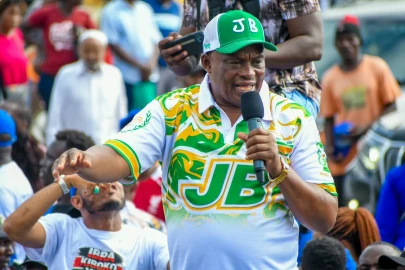
Meanwhile, Hassan Joho — now Cabinet Secretary for Mining, Blue Economy and Maritime Affairs — has been busy delivering the Coast to Ruto in ways that would have been unthinkable when he was Raila Odinga’s most theatrical defender. Standing beside Nassir, Joho told the crowd that the region backs Ruto because “he has dignified us with title deeds and many other development projects,” before adding that the region expects Ruto’s support when they seek the presidency in 2032. His elder brother Abubakar Joho has joined the campaign trail for Ruto too. The family has made its bet.
In Kwale, the tension is just as raw. The broad-based team had quietly settled on Governor Fatuma Achani — backed by Sports CS and former Kwale governor Salim Mvurya — but two credible ODM challengers, Prof Hamadi Boga and engineer Lung’anzi Chai, refused to disappear quietly. Ruto, sensing the room, abruptly changed his tune and told all three contenders to go seek votes from the people rather than rely on external backing. That is a stunning reversal from a president who had been doing the external backing himself.
Prof Boga has been the sharpest voice against the zoning scheme, and he is not wrong. “Zoning at the Coast is a fantasy: you can zone candidates but you cannot zone the voters,” he said, and that line cuts to the heart of Ruto’s problem. Boga warns that coastal politics cannot be settled around a table in Nairobi and then delivered to voters as a finished package — and that if the coalition keeps assuming otherwise, it risks not just losing seats, but losing voters entirely to rebellion or apathy.
In Kilifi, the script played out even more dramatically. The broad-based team publicly backed Governor Gideon Mung’aro, which drove his main challenger, former Gender CS Aisha Jumwa, to quit the government team altogether and move to the Wiper Patriotic Front. Senate aspirant Stephen Kahocho and Ganze parliamentary aspirant Zawadi Kingi are now openly threatening to leave UDA and run as independents. The coalition’s grip is loosening, one defection at a time.
This is the contradiction at the core of Ruto’s Coast strategy: he wants a united front, but unity built on suppressing competition breeds exactly the kind of resentment that destroys fronts. The young voter in Mombasa watching Joho — who once roared against the establishment — now deliver speeches for it, the aspirant in Kwale told to step aside for someone chosen in Nairobi, the Kilifi politician threatening to go independent — they are all sending the same signal. You can build a coalition at the top, but you cannot manufacture loyalty at the bottom. Ruto toured the Coast for eight days. The Coast is still not convinced.