Picture a tout hanging off the door of a matatu on Ngong Road, wind cutting through his jacket, eyes scanning the street for the next passenger. He is not in any tourism brochure. No politician has ever name-dropped him in a manifesto. But without him, this city does not move — not literally, not economically, not at all. Ruitha Maina sees him. And now, through his latest exhibition, so will you.
When You Come to Nairobi, currently running at Wasp and Sprout in Loresho Ridge until October 12, is not the Nairobi of glass towers and Instagram sunsets. It is the Nairobi that wakes up before dawn, that hustles through heat and dust, that speaks in Sheng because the Queen’s English never quite captured what needed to be said. Maina has spent years building this portrait, and the result is an exhibition that feels less like a gallery show and more like a reckoning.
The exhibition brings together three distinct bodies of work — Hustlers of Nairobi, The Yellow Line, and Negative Space — each probing a different layer of the city’s social and economic skin. Together, they form something urgent: a counter-narrative to the official story of Nairobi that is always being sold to us, and that most of us have stopped believing.
Hustlers of Nairobi, begun in 2024, is the series that hits hardest. Life-size works built from acrylic paint, newspaper prints, image transfers and charcoal, they depict the casual and blue-collar workers who keep this city breathing. Maina is not romanticising poverty here — he is doing something more dangerous. He is insisting these people be looked at, really looked at, as full human beings with interior lives and motivations that go beyond survival.
“The blue-collar workers are the humblest people you can meet,” Maina says, “and when you talk to them and you hear their stories, it is about love. They do the jobs for love.” That statement should stop you cold. In a country where the political class talks endlessly about the economy while the people at its base are crushed by it, love is a radical reason to work. Maina understands this. His layered materials — newspaper against paint against charcoal — are not just aesthetic choices. They are arguments about complexity, about the many forces pressing down on a single life.
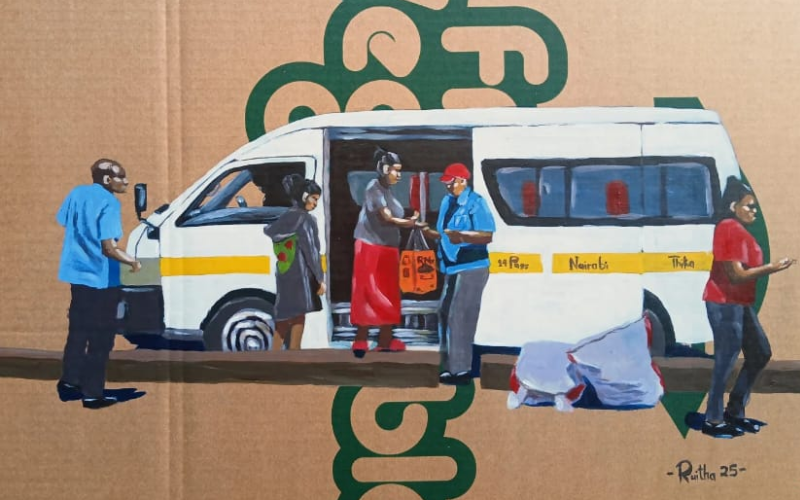
The Yellow Line, started in 2023, moves the lens into the matatu — that chaotic, musical, ungovernable space that is more authentically Nairobi than any boardroom or state house. Maina works on recycled cardboard and cartons, materials that have already lived one life and are being asked to carry meaning again. He is drawn to Sheng, the language that matatu culture helped birth, and he titles his works in it deliberately. Sheng is not slang to Maina. It is a living archive of how young Nairobians have always refused to be defined by the categories handed to them.
Then there is Negative Space — miniature matatus placed within small, deliberately constrained sections of canvas, surrounded by abstracted, churning backgrounds. “It illustrates how we are very small in a very big ecosystem,” Maina explains, “and how sometimes we feel we are very small in a very large world.” For young Kenyans who have watched opportunity shrink while cost of living explodes, that feeling is not philosophical. It is Tuesday morning.
What Maina has built across these three series is a Nairobi that refuses to be flattened. He grew up in this city, and working on this exhibition has shifted not just how he sees its streets but how he understands the political and economic machinery grinding beneath them. That shift shows. This is art made by someone who is paying attention — and who is angry enough, and skilled enough, to make you pay attention too.
The city beyond its skyline has always been there. Ruitha Maina is simply making sure you can no longer look away.