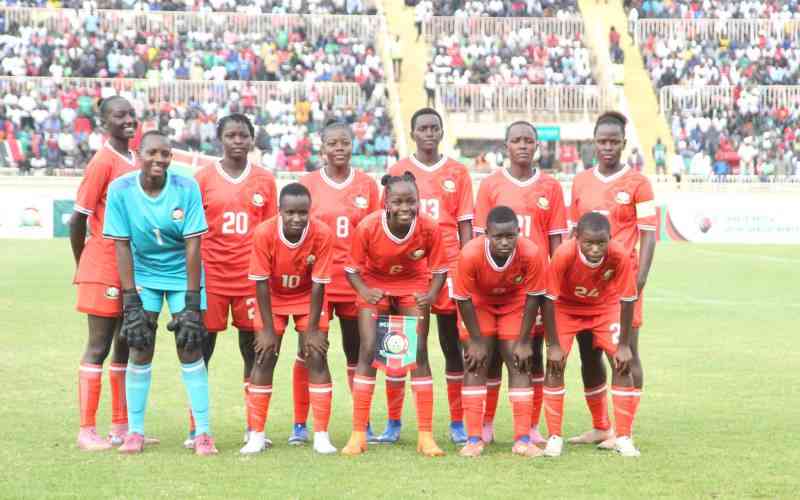
They did it again. Kenya’s Junior Starlets are heading to a second consecutive FIFA U-17 Women’s World Cup, and if you slept on this story, you need to wake up right now.
It didn’t happen overnight. This journey started months ago, when a group of teenage girls boarded a flight to Pretoria with one mission: silence the Bantwana on their own turf. They came back with a 2-0 first-leg win. South Africa — a country with far more football infrastructure, funding, and regional clout — had been put on notice. Kenya was coming.
Sunday’s second leg at Nyayo National Stadium was supposed to be the formality. It wasn’t. South Africa’s captain Katleho Malebana exploited a defensive lapse in the fifth minute, scoring to make it 1-0 on the day and inject just enough panic into the air. For a moment, the roar of the crowd dipped. Bantwana controlled possession and pinned Kenya deep in their own half for long stretches of the first half, hunting the goal that would bring the tie back to life.
But these girls don’t fold. That much was already proven in the Dominican Republic in 2024, when Kenya became the first Kenyan football team — men’s or women’s, any age group — to ever play at a FIFA World Cup. They beat Mexico in that tournament. Mexico. So no, a one-goal deficit against South Africa at home was not going to break them.
The second half belonged entirely to the Junior Starlets. Gaudencia Maloba — who had called on the President himself to show up and watch — delivered on her promise with a composed header in the 70th minute to level the score. Then came the penalty, calmly slotted home by Brenda Awuor. Then substitute Elizabeth Alizeba, barely off the bench, sealed it with a clinical finish that sent Nyayo into full celebration mode. Final score: 3-1 on the day, 5-1 on aggregate. It wasn’t even close.
Behind all of this stands head coach Mildred Cheche, who has now done something no Kenyan coach — male or female — has ever done: led a national football team to two FIFA World Cups. Before Cheche took charge, Kenya had never qualified for any FIFA World Cup in football. She has now done it twice, back to back, with a squad of teenagers. The football federation will have to reckon with what she’s building here, because this is not a fluke.
Before the match, Cheche had been clear-eyed about the approach. “For every game, we prepare for all situations. We prepare for a draw, a loss and a win, but at this particular moment we were preparing for a win,” she said. That mindset — no complacency, no assumptions — filtered straight through to her players on the pitch.
The #BringTheGameHome campaign worked. Nyayo was packed. Fans who have spent years watching Kenyan football disappoint them showed up anyway, and the team gave them something real in return. That relationship — between a young, hungry squad and a fanbase desperate for something to believe in — is exactly what Kenyan football has been missing for decades.
Kenya will now travel to Morocco for the 2026 FIFA U-17 Women’s World Cup, running from October 17 to November 7, 2026. The tournament will be harder. The opposition will be faster, more technical, and better resourced. The first half against South Africa exposed a real weakness — Kenya struggled to hold possession and were pinned back for long periods — and that has to be fixed before Morocco. Against the best teams in the world, you cannot survive on resilience and clinical finishing alone.
But here is what matters right now: Kenya is going. A coach who believed in a system, a group of girls who refused to accept that Kenyan football is destined to underperform, and a stadium full of supporters who showed up when it counted — that combination produced history. Twice. Don’t let anyone tell you this is small. This is exactly the kind of story that changes what a country believes is possible.