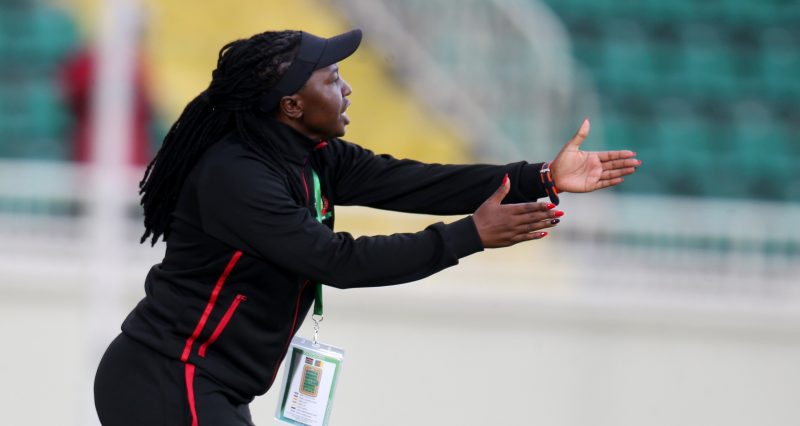
There is something quietly extraordinary about a group of teenage girls from Kenya preparing to face China and the United States on a World Cup stage, and something deeply frustrating about the fact that some of them aren’t even allowed to show up to training. That tension — between the scale of the moment and the mundane obstacles blocking the path to it — sits at the heart of what Junior Starlets head coach Mildred Cheche is dealing with right now, less than five weeks before Kenya kicks off its second-ever appearance at the FIFA Under-17 Women’s World Cup in Morocco.
Cheche is scrambling. Four players are yet to report to the residential camp in Kasarani, three of them from Butere Girls High School, whose administration has simply not released them. “They are missing out on a lot,” Cheche said, and that is not a throwaway line — it is a quiet alarm. Every day of camp is a day of tactical drilling, physical conditioning, team chemistry-building. Every day those girls sit in a classroom instead of a training pitch is a day they fall behind. Cheche says she has sent communication to the school. She is waiting. The World Cup, meanwhile, is not waiting for anyone.
Then there is Mwanakombo Bakari, who was a key engine in Kenya’s qualification for this tournament. Bakari has since travelled to the United States on a scholarship, and her availability for the World Cup is uncertain at best. Cheche is hopeful she joins the squad at some point during the tournament window, but hope is a thin substitute for a player who helped get the team there in the first place. The cruel irony is that the same ambition and talent that made Bakari indispensable to this squad is exactly what earned her an opportunity that now pulls her away from it.
Despite all of this, Cheche is not flinching. She knows what her girls are walking into — Group E, which pairs Kenya with China, the United States and Samoa, a draw that pundits have already branded a group of death. She refuses to accept that framing as a verdict. “The quality we have, I think it’s very much possible to go beyond the group stages,” she said, and you get the sense she means it, not as a PR line, but as a genuine tactical assessment. She knows her squad. She has built something here, and she believes in it.
What grounds that belief is history — specifically, what happened in 2024 at the Dominican Republic, when Kenya became the first football side from the country to qualify for a major international competition. That squad lost to England and got hammered by North Korea, but then they beat Mexico 2-1 in their final group game, and that victory mattered beyond the scoreline. It proved these girls could compete. It proved the programme was real. The current squad is largely different from those predecessors, but they carry that win with them like inherited muscle memory, proof that the impossible is negotiable.
Cheche is clear-eyed about one thing: the approach that worked in qualification will not work in Morocco. She has made deliberate changes, added players she believes will give the team a sharper edge, and shifted the tactical philosophy to account for opponents who are physically imposing and tactically sophisticated. “We are going to play with a physical side and also tactically intelligent,” she said, and the camp in Kasarani is built around exactly that — technique, physicality, mentality, tactics, the four pillars she believes will determine whether Kenya advances or goes home after the group stage. The chemistry, she adds, is already there, because most of these players have competed together in school football, which means the relationships are not being manufactured from scratch.
Kenya opens against China on October 19 at the Mohamed VI Football Academy, then faces the United States three days later at the same venue, before closing the group stage against Samoa on October 25. The schedule is brutal, the opponents are formidable, and some of the players aren’t even in camp yet. But this is Kenya’s second World Cup in two years, and that alone tells you something real is being built here — something worth fighting for, something worth showing up for, even if certain schools have not yet figured that out.