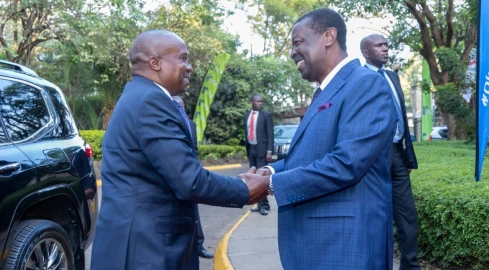
There is something almost theatrical about Kenyan politics — the way alliances shift like sand, loyalties evaporate overnight, and yesterday’s enemy becomes today’s running mate. So when Prime Cabinet Secretary Musalia Mudavadi stood before a crowd in Tharaka Nithi County last week and declared, without flinching, that Professor Kithure Kindiki should remain Deputy President after 2027, it was not just a political endorsement. It was a statement of intent from a man who understands, better than most, that in this game, timing is everything.
Mudavadi was in Tharaka Nithi for the launch of the county’s new headquarters — a moment of ceremony, yes, but also an unmistakable opportunity to plant a flag. He praised Kindiki as a loyal and capable deputy to President William Ruto, arguing that continuity in leadership would protect the momentum of ongoing development projects. “Chini ya serikali ya broad-based tutazidi kufanya kazi kwa pamoja,” he said, invoking the broad-based government framework that has become the Kenya Kwanza administration’s political scaffolding. Then came the unambiguous line: the Deputy President’s seat belongs to Kindiki, because he has proven his loyalty to Ruto — publicly, consistently, without wavering.
That kind of declaration, delivered in Tharaka Nithi of all places — deep in the Mt Kenya heartland — carries enormous weight. This is not Nairobi political theatre for TV cameras. This is a message sent directly to a community that will be fiercely contested in 2027, a community that Kindiki himself has been working relentlessly to consolidate.
And consolidate he has. Just a few kilometres away, in Kanyakine, Imenti South, Kindiki was doing what he does best: showing up with money and tarmac. He presided over the launch of roads and development projects valued at an estimated Ksh. 39 billion, turning the occasion into a showcase of what he frames as the government’s delivery record. The message to Mt Kenya residents was blunt and deliberate — judge us by what we have built, not by what the opposition promises.
Kindiki did not stop at development optics. He went after the opposition with a sharpness that suggests he is not waiting for 2027 to begin campaigning. He challenged opposition leaders to account for what they actually delivered when they held power, dismissing their current rhetoric as hollow. “Msisikize wale watu ambao wanakuja hapa na maneno matupu kwani wakati walikuwa kwa ofisi waliwafanyia nini?” he told the crowd — a line that lands harder when you remember that many of those opposition figures governed this country for years and left little behind for ordinary Kenyans to point to.
He also took a pointed swipe at what he called the politics of nicknames — the Kasongo, the Soprano, the theatrical insults that have become a staple of opposition social media strategy. “Hii maneno ya nickname ni utoto,” he said flatly. Childishness. It is a calculated reframe: Kindiki is positioning himself as the serious adult in the room, the technocrat-turned-politician who has receipts, while his opponents perform for Twitter.
But here is what young, politically conscious Kenyans should sit with: this is not simply a story about one politician endorsing another. This is a coordinated political architecture being assembled in plain sight. Mudavadi calling for tighter UDA-ODM cooperation ahead of 2027 while simultaneously backing Kindiki for the Deputy Presidency is not accidental. It signals that the broad-based government — a formation that many Kenyans received with deep suspicion after the Gen Z protests of 2024 — intends to run as a unified bloc, with Kindiki as a central pillar.
Tharaka Nithi Governor Muthomi Njuki added another layer to the day’s messaging, warning that leaders who rely on insults rather than substance will not win elections. “Huwezi win election kama hiyo ndio njia,” he said. It reads like a rebuke aimed at the opposition, but it also functions as a discipline call to government allies — stay on message, stay on development, do not get dragged into the mud.
The opposition, for its part, has not been silent. The nicknames Kindiki dismisses as childish have drawn enormous crowds and generated genuine enthusiasm among young Kenyans who feel that the current administration has not delivered on its promises — that the cost of living remains brutal, that the Finance Bill protests were met with live ammunition, that accountability remains a distant concept. Those grievances are real. They do not disappear because Kindiki unveils a road in Meru.
What 2027 will ultimately come down to is whether the government’s development narrative — roads, headquarters, billions in projects — can outweigh the lived economic pain that millions of Kenyans carry every single day. Mudavadi and Kindiki are betting it will. They are betting that Mt Kenya, properly locked in, tips the balance. They are betting that loyalty, continuity and tarmac beat anger and wit.
That bet may or may not pay off. But one thing is already settled: the government’s 2027 machine is running, it is coordinated, and Kithure Kindiki is sitting squarely in its centre seat.