
It was a Monday morning like any other at Gikomba Market — the kind of morning where the air smells of secondhand clothes and fresh mandazi, where traders call out to passersby and matatu touts compete for every shilling. Moreen Nduku, 44, was there on routine errands. So was Abdala Lihan, sixteen years old, with his whole life ahead of him.
Neither of them went looking for trouble. Trouble found them anyway, wearing a uniform and carrying a gun.
The Shot That Changed Everything
On August 3rd, police officers stormed Gikomba, claiming they were pursuing phone thieves. What followed is the kind of sequence that has become sickeningly familiar in this city. Officers fired shots. And then, in the chaos of a moment that should never have happened, a bullet tore through Moreen’s abdomen and lodged itself into Abdala’s leg. Abdala remembers it with the kind of clarity that only trauma can produce — the officers lined people up, one of them raised his rifle, a magazine was passed between two officers, and when it snapped into place, the gun discharged. Just like that. A mother of one, shot through the stomach. A teenager, collapsing with a bullet in his leg.
Moreen was rushed to the Kenyatta National Hospital and placed in the ICU. She fought for four days. On Friday, she lost. Abdala survived, but the bullet that entered his body — the very piece of evidence that could hold someone accountable — has since disappeared.
The Disappearing Evidence
This is where the story stops being a tragedy and becomes something darker. X-ray images confirmed the bullet’s path: it entered Moreen’s body, exited, and embedded itself in Abdala’s leg. That bullet was physical proof. It existed. And then, according to the family, it didn’t.
In the days after the shooting, police officers were spotted at the hospital, circling. They asked nurses when Abdala would go into theatre. They wanted to know when the bullet would be removed. Hussein Khalid, CEO of Vocal Africa, didn’t mince words about what he believes was happening: “There is a clear attempt to cover up.” One nurse reportedly told the officers they would have to follow the right procedure. The officers left. And somewhere between that conversation and the moment the bullet should have been handed to investigators, it vanished.
The Independent Policing Oversight Authority — the body that exists precisely for moments like this — has said nothing. The officer involved is believed to be attached to Shauri Moyo Police Station. That detail alone should be enough to open a full investigation. It hasn’t been.
A Family Left to Fight Alone
Abdala’s mother, Stela Mwalimo, stood in front of the officers who shot her son and asked them a question that deserved a real answer: were there no other ways to catch thieves? The officer told her the criminals had been causing serious trouble at the bridge. As if that explained anything. As if that justified a bullet passing through a woman’s stomach.
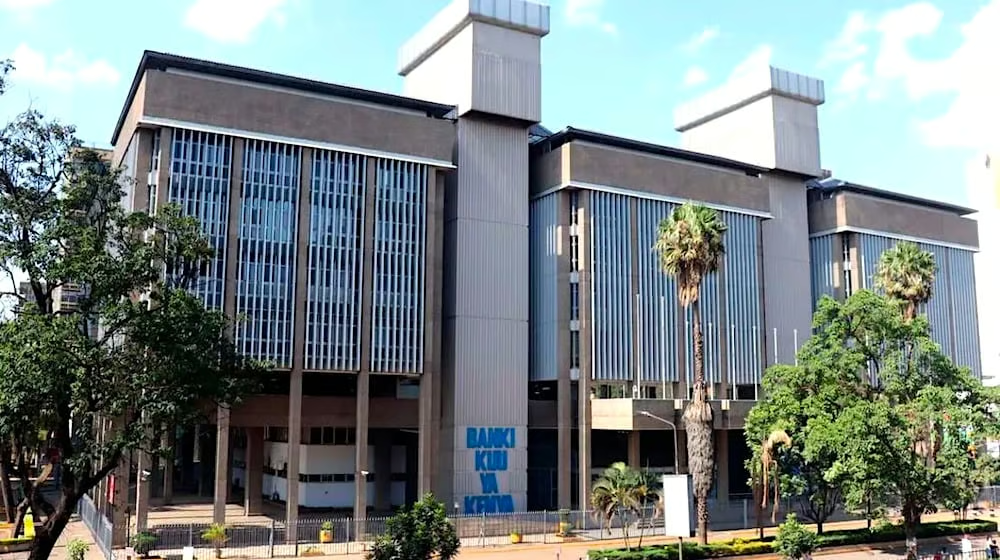
Now the police are reportedly trying to shift the story entirely, suggesting that other criminals in the area may have fired the shot. Khalid called it out directly: if you weren’t the one who fired, why were your officers at the hospital asking about that bullet? Why is IPOA not in possession of it? And why does Kenyatta National Hospital need to answer for where it went?
What This Means for the Rest of Us
Moreen Nduku was not a statistic. She was a mother. She went to Gikomba on a Monday morning and never came home. Her child is growing up without her, and the man who fired the shot that killed her may never face a single consequence — because the one piece of evidence that could prove what happened has been made to disappear.
This is the system working exactly as it was designed to. Not for us. Not for Moreen’s family. Not for Abdala, who carries the memory of that day in his body and in his mind. The question is no longer just who fired the gun. The question is who took the bullet — and who let them.