
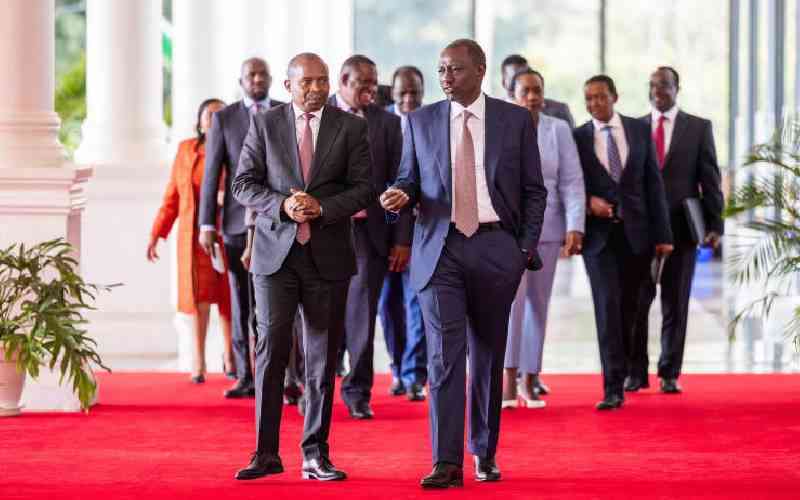
What is actually happening here?
President William Ruto is being forced — not choosing — to reshuffle his Cabinet. A court order has made it inevitable, and that distinction matters enormously. This is not a voluntary act of political goodwill or a president reading the room. This is accountability arriving through the judiciary because it could not arrive through the ballot box or the streets, even after young Kenyans literally bled for it.
The reshuffle has reignited a conversation that never really went away: who exactly is sitting in Kenya’s Cabinet, how did they get there, and why does it feel like the same faces keep rotating through power regardless of what the public demands?
How did we get here? The Gen Z protests changed everything — and then nothing
Cast your mind back to 2024. Young Kenyans, many of them first-time protesters, flooded the streets with a clarity of purpose that shook the political establishment to its core. Among their central demands was the removal of Cabinet ministers they identified as symbols of incompetence, unchecked corruption, and a government that had stopped pretending to care about ordinary people. The pressure worked — at least on the surface. Ruto dropped his entire Cabinet in a dramatic gesture that felt, briefly, like a genuine reckoning.
It was not.
In the weeks and months that followed, the President quietly re-appointed a significant majority of those same ministers. The faces that had become synonymous with public fury were back at the table, their titles intact, their accountability untouched. That slow, calculated reversal is precisely what triggered a court petition — and it is why we are here today.
Why does recycling ministers matter so much?
There is a specific kind of political cynicism embedded in reappointing officials who have already lost public trust, and it sends a message that is impossible to misread: your anger was noted, managed, and ultimately ignored. When a minister who presided over a dysfunctional ministry is handed back the keys to that same ministry — or worse, a different one — it signals that performance is irrelevant to political survival in Kenya. What matters is proximity to power, not service to the public.
For young, politically engaged Kenyans who invested real emotional and physical stakes in the 2024 protests, this recycling is not just frustrating. It is a direct refutation of the idea that civic participation produces change. And that erosion of belief in participation is arguably more dangerous than any single bad minister.
The competence question
Critics have consistently pointed to specific patterns of underperformance in key ministries — delayed service delivery, opaque procurement processes, and a culture of impunity that filters down from the top. When the same individuals cycle back into those environments without consequence, the institutional rot does not reset. It deepens. The problem is structural, and reappointment without accountability is how structures calcify into something permanent.
The corruption question
Corruption allegations that surrounded several of the dropped ministers did not disappear when they were reappointed. They were simply deprioritised. In a political culture where the threshold for removal is a street protest rather than an investigation or a conviction, the signal to every public official is clear: hold on long enough, and the storm passes.
What does the court-ordered reshuffle actually change?
This is where smart skepticism is warranted. A court order compelling a reshuffle does not guarantee that the replacements will be meaningfully different. Ruto retains the discretion to determine who fills those seats, and a reshuffle driven by legal obligation rather than genuine reform instinct could easily produce a new set of familiar names — different faces, same networks, same incentives. The architecture of patronage politics does not collapse because a judge issues an order.
What the court order does accomplish, however, is establish a precedent. It demonstrates that the executive’s Cabinet appointments are not beyond legal challenge, that citizens and civil society have standing to contest decisions that violate constitutional principles, and that the judiciary — when it functions — can serve as a genuine check on presidential overreach. That is not nothing. In Kenya’s political context, it is actually significant.
What should you be watching for?
The names Ruto announces will tell you everything you need to know about whether this reshuffle is cosmetic or consequential. Watch for whether individuals with pending corruption investigations appear on the list. Watch for whether the ministries most criticised during the Gen Z protests receive genuinely new leadership or simply reshuffled loyalty. Watch for whether the President uses this moment to bring in technical expertise and fresh voices, or whether he uses it to reward political allies who supported him through a difficult year.
The reshuffle is coming. The question is whether it means anything at all — and that answer belongs to every young Kenyan who still believes that paying attention is a form of power.