
Picture a senior government official sitting in a county office, stripped of his budget, ignored on WhatsApp, and watching his junior officers handle work that was constitutionally his — yet still showing up every day, leading street operations, waiting for a phone call from his boss that never came. That was Geoffrey Mosiria’s reality, if you believe what he says. And after his formal dismissal on Wednesday, October 21, he has decided you should hear all of it.
Within minutes of Nairobi Governor Johnson Sakaja announcing his sacking through County Secretary Dr Machel Waikenda, Mosiria fired back on his official social media accounts with a statement that reads less like a farewell and more like an indictment. The former Chief Officer did not go quietly. He went loud, specific, and angry — and the details he laid out deserve serious scrutiny from anyone paying attention to how county power actually works in this city.
Mosiria’s central claim is blunt: Sakaja effectively dismissed him on 28th December 2023, nearly two years before the official announcement. That was the day, Mosiria says, that the Governor summoned him to his private office in Riverside and stripped him of his mandate as an Accounting Officer in the health docket — a constitutionally assigned role — handing those responsibilities instead to junior officers in what Mosiria describes as a blatantly unprocedural move. The trigger, he alleges, was his refusal to facilitate direct procurement arrangements that would have benefited individuals close to the Governor and certain contractors. He named the Governor’s Chief of Staff, one Osman Khalifa, as a participant in a WhatsApp conference call during which Sakaja confronted him over his position on those procurement matters.
What followed, Mosiria says, was a slow and deliberate suffocation. His health docket budget was slashed from Ksh. 1.2 billion to Ksh. 100 million — a cut so severe it rendered meaningful service delivery almost impossible. He was then transferred to the Environment docket, where his own director reportedly bypassed him entirely, reporting straight to the Governor. Mosiria claims he was left with virtually nothing to do, so he took to the streets himself, leading operations that should have been delegated downward, simply to feel useful, simply to serve Nairobi residents in some capacity.
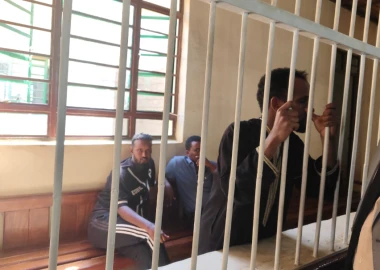
The frustrations did not stay internal. Mosiria describes sustained attacks in official WhatsApp groups, public character assassination, and — most seriously — a court case that brought him to the edge of a six-month jail sentence for alleged contempt of court. He is unambiguous about what he believes that case was: a manufactured mechanism to force him out of office. After surviving it, he was transferred again, this time to the Public Participation, Citizen Engagement and Customer Service docket — a posting that, in the brutal arithmetic of county politics, reads like a demotion dressed in bureaucratic language.
“I endured frustrations, official WhatsApp group attacks, public attacks, and a court case that nearly saw me jailed for six months over alleged contempt of court, which was well planned to kick me out of office, and when I asked why, what followed was a transfer to customer service,” Mosiria said. There is something almost darkly comic about that sentence, until you remember that real people depend on Nairobi’s county services every single day.
He stayed. That is what makes this story complicated. Mosiria admits he remained in post through all of it, hoping — his word — to regain Sakaja’s trust. He says his last substantive meeting with the Governor was that December 2023 confrontation in Riverside. After that, calls went unanswered, messages went unreturned, and the silence from the top became its own kind of answer.
The timing of the official dismissal is impossible to separate from politics. Just days before Sakaja signed off on the sacking, Mosiria had publicly declared his intention to challenge the Governor for the Nairobi seat in the 2027 General Election, branding himself “Mr Fix-it” and positioning himself as the man who could finally address the capital’s chronic failures. Sakaja’s office has not publicly addressed whether that declaration influenced the decision. It does not need to. The sequence speaks for itself, and Nairobi’s young voters — the ones who have watched this city’s roads flood, its garbage pile up, and its health facilities crumble — are smart enough to read it.
Mosiria insists his political ambition is not about personal war. “My desire has never been to fight anyone; it has always been to fix the systems and serve the people of Nairobi,” he said. Whether that holds up under the weight of what is clearly a deeply personal grievance remains to be seen. But one thing is certain: the story of how Nairobi is governed — who gets sidelined, who gets contracts, and who gets to decide — is no longer confined to the corridors of City Hall. It is out in the open now, and it belongs to the people of this city to judge.