
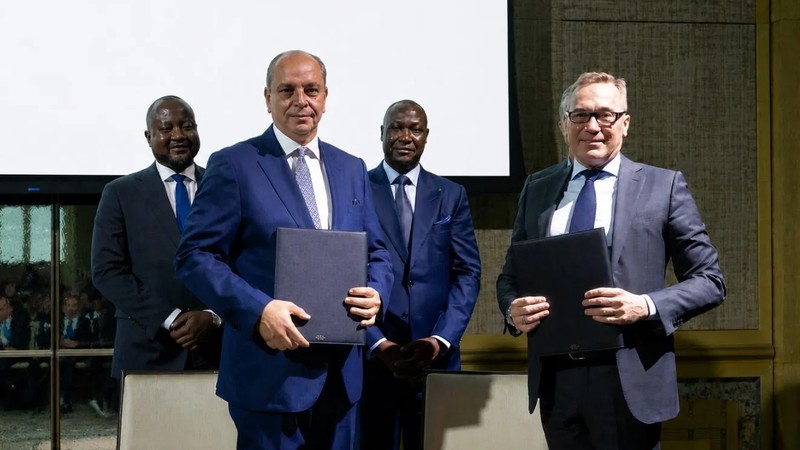
Africa Finance Corporation Launches $100M Tech Fund — And It’s About More Than Money
Africa Finance Corporation (AFC) has approved a $100 million commitment to invest in Africa-focused technology fund managers — a move that directly challenges the long-standing dominance of foreign capital in the continent’s venture ecosystem. This isn’t charity. This is strategy.
Why This Matters Right Now
African tech startups raised just $3.4 billion in 2025, already down from previous years. Worse, Africa-focused fund managers raised only $107 million across six final closes — an 87% year-on-year collapse — as European venture investors quietly packed their bags and left. The continent’s builders were being abandoned at exactly the wrong moment.
Meanwhile, Africa’s digital economy is projected to contribute over $700 billion to GDP by 2050. The gap between that potential and the capital available to unlock it is not a market failure. It’s a political and institutional failure — one AFC is now moving to correct.
Who Gets the Money
AFC has already made two anchor investments from the fund: $25 million to Lightrock Africa Fund II and $15 million to Future Africa Fund III. The remaining $60 million will be deployed across additional fund managers currently under review.
The sectors in focus are the ones shaping Kenya’s daily life right now: fintech, digital infrastructure, consumer technology, artificial intelligence, and education technology. From M-Pesa successors to AI-powered learning tools, this capital is aimed squarely at the problems young Africans are already solving.
The Lightrock Bet
Lightrock Africa Fund II already has skin in the game — its portfolio includes Moniepoint, Lula, and M-KOPA, companies with proven models and real users across the continent. AFC’s $25 million anchor signals institutional confidence in businesses that have moved past the hype and into profitability.
Pal Erik Sjatil, Managing Partner and CEO of Lightrock, called the partnership a “shared conviction” in backing high-growth, technology-enabled businesses with “clear pathways to profitability.” That’s not investor-speak. That’s a bet on Africa’s fundamentals.
Future Africa: Betting on the Builders
The $15 million commitment to Future Africa Fund III targets the earliest stage of the innovation pipeline — the founders who are still figuring it out, still building, still hungry. Future Africa’s focus on financial inclusion, connectivity, and education technology means this money reaches the problems closest to ordinary Kenyans.
Iyin Aboyeji, Founding Partner of Future Africa, put it plainly: “Young Africans are not waiting for the digital economy to arrive; they are already among its most active participants globally. What they need now are the skills, productive assets and infrastructure to build and scale within it.”
AFC Is Changing Its Own Rules
This is a significant pivot. AFC was established in 2007 to finance hard infrastructure — ports, power, oil and gas, subsea cables. It has largely stayed in that lane. The $100 million fund-of-funds structure is a deliberate expansion into early and growth-stage venture capital, without abandoning its preference for large, balance-sheet-deployed investments.
AFC President and CEO Samaila Zubairu framed it clearly: “Digital infrastructure is now as fundamental to Africa’s transformation as roads, rail, ports and power.” That’s an institutional acknowledgment that the old infrastructure playbook is incomplete.
The Bigger Problem This Is Trying to Fix
Here’s the uncomfortable truth: African institutional investors are almost invisible in African venture capital. The bulk of funding still comes from foreign sources — European development finance institutions, American endowments, global family offices. When those investors retreat, as they did dramatically in 2024 and 2025, African founders are left exposed.
AFC’s initiative is explicitly designed to change that power dynamic. The emphasis on African-owned fund managers is not a footnote — it’s the point. Capital that stays on the continent, managed by people who understand the continent, is more likely to stay invested when global markets turn volatile.
The Numbers Behind the Optimism
What Comes Next
AFC says the two initial commitments are just the first tranche. The corporation is actively evaluating a pipeline of additional Africa-focused funds across a range of strategies and stages, with further commitments expected soon.
For Kenya’s startup founders, tech workers, and young investors watching from the sidelines: this is what institutional backing looks like when it finally shows up. The question now is whether it arrives fast enough — and whether it reaches the people who need it most.