
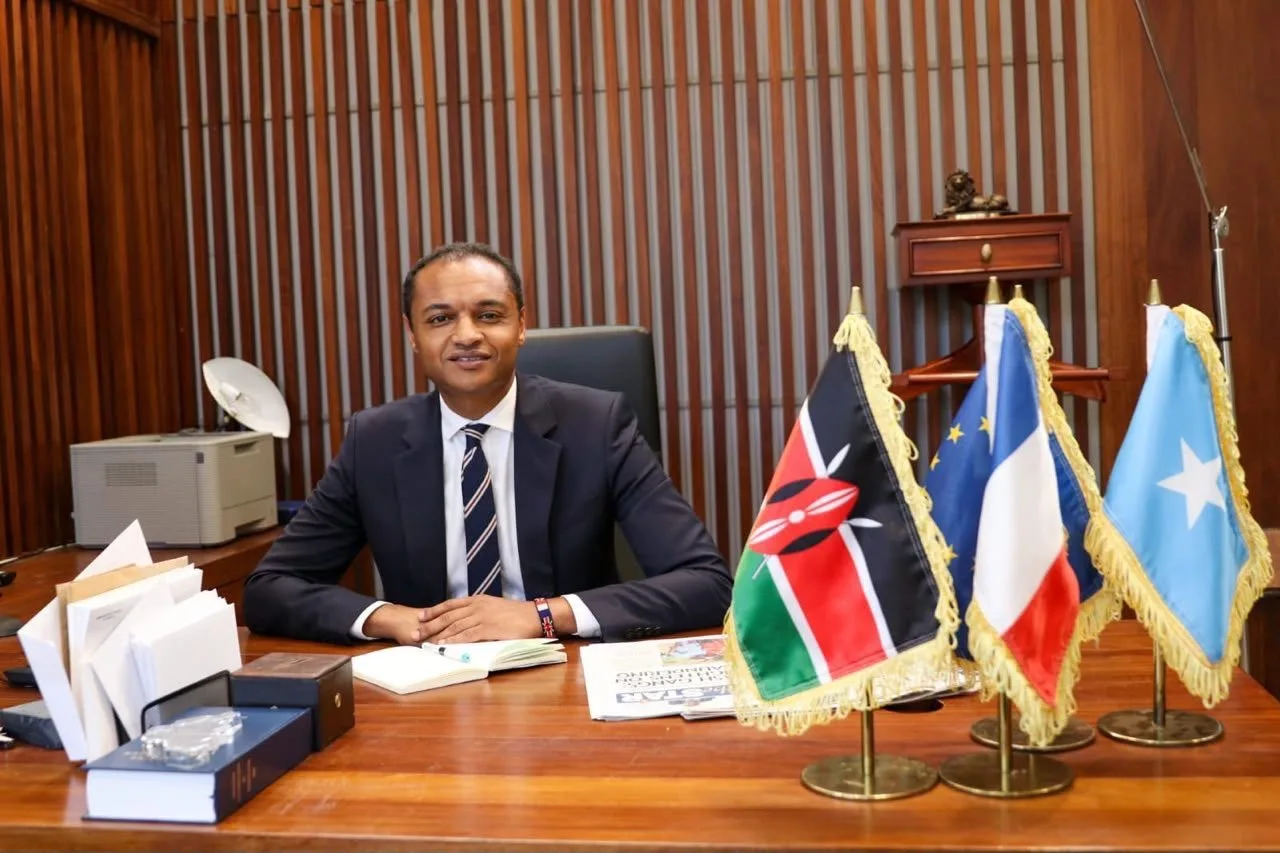
A new French ambassador has landed in Nairobi, and the question worth asking is not who he is replacing — but what he is walking into.
Wadid Benaabou has been appointed France’s new Ambassador-designate to Kenya, succeeding Arnaud Suquet, who wrapped up a four-year posting that, by any honest measure, was not your typical diplomatic stint. Suquet learned Kiswahili from children’s books, rode matatus, attempted Sheng — and reportedly failed at it, which, fair enough — ate Kenyan food, ran alongside Eliud Kipchoge and Emmanuel Macron during the Africa Forward Summit, and left the country with a farewell message so warm it barely read like a government communiqué. Kwaheri Kenya tutaonana baadaye. Asanteni. That is not the language of a man who spent four years in a diplomatic bubble.
So who is Benaabou, and what does he actually want here?
Benaabou arrives with a background in multilateral diplomacy, having worked at the French Ministry of Foreign Affairs and at France’s representation to the United Nations — which means he knows how to navigate the kind of high-stakes, multi-party environments that Kenya increasingly finds itself at the centre of, whether that is climate negotiations, East African security arrangements, or the scramble for continental influence. His mandate covers not just Kenya but also Somalia and France’s representation to the UN Office in Nairobi, the same portfolio Suquet held, which tells you something about how France views this posting: it is a strategic hub, not a backwater assignment.
His opening statement was careful, measured, and precisely what you would expect from a seasoned diplomat — “France and Kenya share a strong partnership, rooted in friendship and a shared ambition for the future” — before he threw in a Niko tayari that signals, at minimum, an awareness that his predecessor set a cultural bar worth acknowledging. Whether that translates into genuine engagement or remains a diplomatic flourish is something only time will expose.
What is not in question is the context he is inheriting. Kenya and France are actively seeking to deepen ties across trade and investment, security cooperation, climate action, and multilateral diplomacy at a moment when the competition for African partnerships — from China, the Gulf states, the United States, and Russia — has never been more explicit or more consequential. France, having lost significant ground in francophone West Africa, needs its relationships in East Africa to hold and to grow. Kenya, for its part, has been playing its diplomatic hand with increasing confidence under President Ruto, who formally bid farewell to Suquet at State House — a gesture that signals the relationship is being taken seriously at the highest level.
Suquet leaves behind something genuinely rare in diplomatic circles: goodwill that feels earned rather than performed. He wrote of drinking Kenyan tea in Paris while remembering the slopes of Murang’a, and promised to return — not as an ambassador, but as a French citizen with a deep affection for this country. That is a hard act to follow, and Benaabou knows it. The real test is not whether he can match the warmth of his predecessor’s exit, but whether he can translate France’s strategic interests into something that actually benefits Kenyans — not just French investment portfolios and geopolitical positioning. That distinction matters. And young Kenyans, who have grown sharply skeptical of foreign engagement that talks partnership while practicing extraction, will be watching closely.