The Pitch Kenya Made to the World
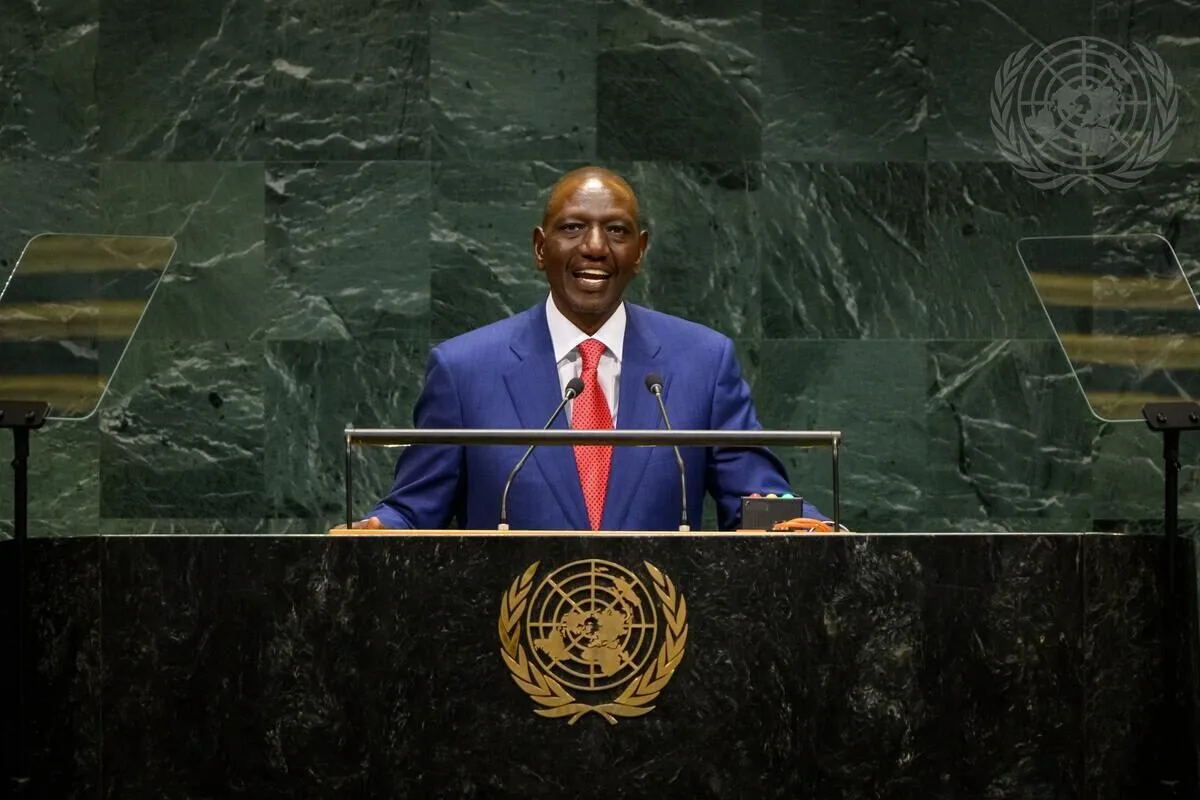
While most Kenyans were grinding through another week of high costs and economic uncertainty, President William Ruto was in New York at the 81st United Nations General Assembly, making promises on their behalf. The question you should be asking is not what was signed — it is whether any of it will actually land back home.
Kenya’s delegation did not go to UNGA to take photographs. The government signed or advanced eleven major instruments and agreements during the High-Level Week, anchoring its engagement around a single, ambitious idea: that foreign policy is no longer just about flags and handshakes — it is an economic weapon. Whether Ruto’s administration can wield it effectively is an entirely different conversation.
The $750 Million Industrial Deal
The headline figure from the entire UNGA week is a partnership between Kenya and the United Nations Industrial Development Organization — UNIDO — covering the period 2026 to 2030. The Country Partnership Programme comes with approximately $750 million in associated investment opportunities, targeting industrial investment, technology transfer, manufacturing, enterprise development and job creation.
That number demands scrutiny. Kenya has signed ambitious frameworks before. What makes this one different, at least on paper, is its specificity: a five-year window, a named implementing body, and a clear focus on moving Kenya away from exporting raw materials toward processing and manufacturing them domestically. That shift — from raw commodity exporter to value-adding economy — has been the stated dream of every administration since independence. Ruto’s team is betting UNIDO can help make it real.
An East African Refinery and Nairobi’s Financial Ambitions
Beyond the UNIDO deal, Ruto held discussions with Africa’s richest man, Aliko Dangote, and African Finance Corporation President Samaila Zubairu about a proposed East African refinery to be based in Kenya. The conversation also covered the establishment of an AFC regional office in Nairobi.
This is not a small ambition. A regional refinery would fundamentally alter Kenya’s energy economics, reducing dependence on imported refined petroleum products that currently drain foreign exchange reserves and keep fuel prices punishingly high. For the young Kenyan paying Sh200 per litre at the pump, that conversation in New York is directly relevant — even if the connection feels distant right now.
Nairobi’s push to become a regional financial hub has been building for years, and the AFC office would add institutional weight to that claim. The government also signed a Host Country Agreement for the United Cities and Local Governments of Africa East African Regional Office in Nairobi, further cementing the capital’s multilateral footprint.
AI, Stanford, and Kenya’s Digital Bet
The Anthropic Declaration
Kenya signed a Joint Declaration on Responsible AI, Research and Innovation with Anthropic PBC — the company behind the Claude AI system. The declaration covers AI cooperation, research and innovation, with priority areas including data governance, fiscal transparency, investment efficiency and institutional capacity.
Read that carefully. Fiscal transparency and investment efficiency are not abstract goals — they are direct responses to the corruption and opacity that have historically swallowed Kenya’s development budgets. If AI tools can actually improve how public money is tracked and spent, that matters to every Kenyan who has watched infrastructure funds disappear into procurement scandals.
The Stanford Partnership
Kenya also signed two instruments with the Emerging Markets Working Group at Stanford University’s Hoover Institution, covering economic transformation, governance, technology and public policy, as well as ICT cooperation. The government framed these agreements as tools to position Kenya as an African centre for responsible digital transformation — a claim that needs proof, not just press releases.
Reforming the Global Financial System
Kenya used the General Assembly platform to push hard for reforms to the global financial architecture. The core argument is straightforward: developing countries cannot finance productive investment in infrastructure, education, health, energy and industrialisation when the cost of capital is prohibitively high and financing is tied to conditions that serve creditor interests over borrower needs.
Prime Cabinet Secretary Musalia Mudavadi framed Kenya’s UNGA participation as a direct intervention in this global debate. Ruto’s General Debate address called for equitable African representation in multilateral institutions and access to long-term, affordable, local-currency financing. These are not new demands — African leaders have made them for decades. What changes is whether the current geopolitical moment, with Western institutions under pressure and new financing alternatives emerging, gives them more traction.
Climate, Clean Cooking, and the Urban Poor
Kenya’s climate diplomacy at UNGA was substantive. As coordinator of the Committee of African Heads of State and Government on Climate Change, Kenya pushed Africa’s common position ahead of COP31 in Antalya, Türkiye. The government also advanced Africa’s clean-cooking agenda ahead of a Clean Cooking Summit scheduled for Nairobi in January 2027.
Kenya convened a high-level event on building climate resilience among the urban poor — a session that connected climate change directly to housing, poverty reduction and infrastructure. For the millions of Kenyans living in urban informal settlements, climate resilience is not an environmental talking point. It is a question of whether their homes survive the next flood season.
The Diaspora Platform and $4 Billion in Remittances
During Ruto’s engagement with Kenyans living in the United States, the government unveiled the Kenya Diaspora Investment Platform — KDIP — described as a government-led digital platform designed to channel diaspora remittances toward verified development projects at the county level.
Kenyans abroad send home more than $4 billion every year. That figure dwarfs most foreign aid flows into the country. KDIP proposes to use eCitizen as a single digital entry point, with regulated escrow arrangements tied to verified project milestones — a design meant to address the trust deficit that has historically kept diaspora capital out of formal investment channels.
The concept is sound. The execution will determine everything. Kenya’s digital infrastructure has improved significantly, but project verification and escrow management at county level require institutional capacity that has not always been reliable.
New Diplomatic Ties and Judicial Candidatures
Kenya established diplomatic relations with the Solomon Islands and signed political consultation instruments with the Maldives, North Macedonia, Croatia and Trinidad and Tobago — expanding its formal diplomatic network at a moment when global alignments are shifting rapidly.
The delegation also advanced the candidatures of Judge Njoki Ndung’u for the International Criminal Court for the 2027–2036 term and Judge Phoebe Okowa for re-election to the International Court of Justice. Kenyan representation on international judicial bodies is not just symbolic — it shapes how international law is interpreted and applied, including in cases that directly affect African states.
Ruto also met US Secretary of State Marco Rubio to discuss trade and the future of the African Growth and Opportunity Act — AGOA — a preferential trade framework whose renewal remains uncertain under the current US political climate.
Implementation Is Where Kenya Always Stumbles
Mudavadi acknowledged the obvious at the end of the UNGA period: the real test is not what gets signed in New York — it is what gets built in Nairobi, Kisumu, Mombasa and every county in between. “The next priority is implementation — translating commitments into investment, jobs, technology transfer, stronger institutions and tangible benefits for the Kenyan people,” he said.
That sentence carries the weight of every ambitious framework Kenya has signed and subsequently shelved. Eleven agreements advanced in one week is an impressive diplomatic sprint. Converting those agreements into factories, jobs, cheaper fuel and functional AI governance tools is a marathon that Kenya’s institutions have historically struggled to finish.
Young Kenyans — the ones paying the highest unemployment price for decades of policy failure — have every reason to be skeptical. They also have every reason to demand that this time, someone keeps count.