The Fire the Government Undercounted
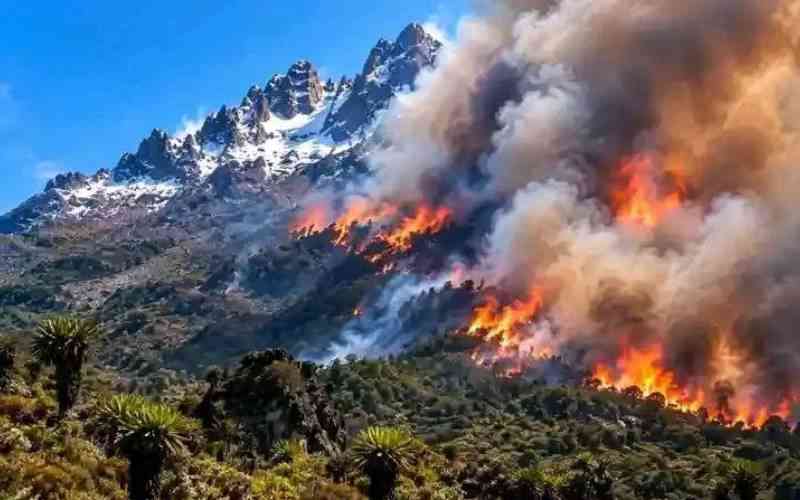
Mount Kenya has been on fire since September 1. Not a small, contained brush fire — a roaring, spreading crisis that has consumed 8,700 hectares of irreplaceable moorland, according to conservation organisation Rhino Ark. That figure is more than twice what the government initially told the public. Let that sink in. While Cabinet Secretary Deborah Barasa was citing figures and touring Meru, the mountain was burning at double the scale officials admitted.
This is not a bureaucratic rounding error. This is a credibility gap. And for young Kenyans who have watched officials manage perception instead of problems — it should make you angry.
The fire started near Rutundu Lodge and quickly became the largest of five separate fire incidents reported across the Mount Kenya ecosystem since August 12. Dry moorland, ferocious winds, and invasive Erica plant species turned what might have been a manageable blaze into a monster that pushed simultaneously toward Marania Forest in the north and Chogoria in the south-west.
Who Is Actually Fighting This Fire?
The KDF is fighting a forest fire. That is where Kenya is right now.
Aerial reconnaissance has helped teams identify hotspots and direct ground operations. By Monday, authorities claimed to have suppressed roughly 85 per cent of the fire. The KFS itself framed it plainly: “We are not yet out of the woods.” No pun intended, presumably.
The Infrastructure Failure Nobody Wants to Own
Here is what this fire has actually revealed: Kenya has no credible rapid-response infrastructure for protecting one of its most ecologically vital ecosystems. Mount Kenya feeds rivers. It anchors biodiversity. It sustains livelihoods for millions of people in surrounding counties. And when it burns, the government scrambles to find roads that can handle emergency vehicles and realises — again — that there is no airstrip to move equipment fast enough.
CS Barasa called for roads to be expanded and an airstrip to be built to allow faster deployment of personnel and equipment during emergencies. These are not radical demands. They are the bare minimum. The fact that she is calling for them during an active crisis, rather than having them already in place, is the scandal hiding in plain sight.
Investigations are underway to determine the cause of the fires. But Kenya’s forest authorities already know that this region burns every dry season. The question was never if — it was always when. And the answer to when should have been a funded, staffed, road-accessible, airstrip-supported response system. It wasn’t.
Wildlife losses appear limited for now. Large animals moved away from the fire fronts. Smaller creatures — rabbits, ground-dwelling species — were not so lucky. But the real loss here is ecological: 8,700 hectares of moorland, a fragile high-altitude biome that takes decades to recover, gone in less than a week.
Mount Kenya is not just a mountain. It is a water tower, a carbon sink, a heritage site, and a symbol. When it burns and the government’s first instinct is to undercount the damage, that tells you everything about whose interests are being protected — and it is not yours.