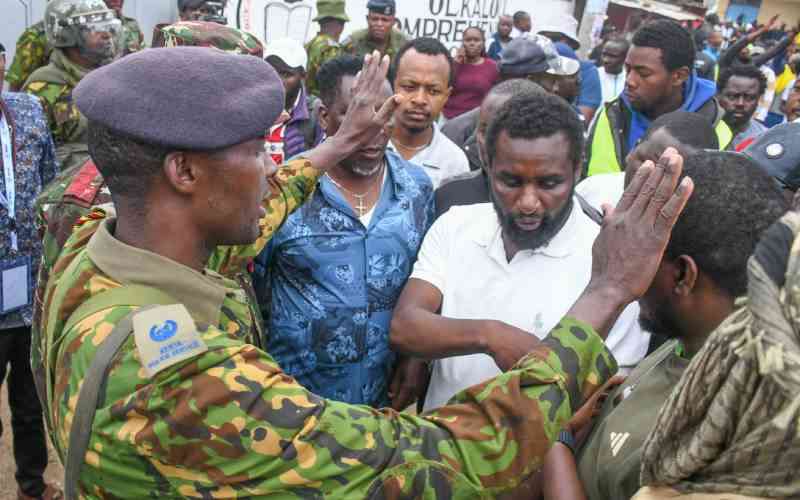
Picture this: it is early morning in Ol Kalou, a constituency most Kenyans associate with the cold highland air and the mountains of potatoes, carrots and cabbages that keep the country fed. Voters have risen before dawn, queued patiently outside 144 polling stations, and convinced themselves that today, their vote will mean something. Then the black Prados roll in.
What unfolded in Ol Kalou’s by-election was not a democratic exercise gone slightly wrong — it was a brazen, coordinated assault on the very idea that ordinary Kenyans have a say in who governs them. Masked men. Chaos. Tear gas hanging in the cold highland air. And everywhere, the quiet, transactional hum of money changing hands — right there, outside the polling stations, sometimes inside the queues themselves, as if the people running this operation had stopped pretending they had anything to hide.
Political operatives moved openly among voters, distributing cash with the casual confidence of people who have done this before and faced no consequences for it. This is the part that should make your stomach turn — not just that it happened, but how unbothered they were about being seen. The bribes were not whispered arrangements made the night before in dark backrooms; they were conducted in the open, in the light of day, in front of a stunned electorate that had shown up in good faith.
Ol Kalou has always been a constituency of quiet, agricultural dignity — the kind of place that feeds the nation without demanding much recognition for it. The people there are not naive. They understand politics. But what they witnessed in this mini-poll forced a confrontation with a truth that many young, politically engaged Kenyans across the country already know in their bones: that the machinery of electoral violence and voter bribery is not a relic of Kenya’s past, it is the present, and it is well-funded, well-organised, and entirely comfortable operating in plain sight.
The goonism — and let us call it exactly that, because euphemisms like “electoral irregularities” are a form of dishonesty — reflects how high the stakes were for whoever deployed those black Prados and those masked men. By-elections in Kenya are often treated as rehearsals, as temperature checks, as opportunities for political networks to flex muscle and test loyalty. Ol Kalou was no different. The violence and the bribes were not panic; they were strategy.
Here is what this moment demands of every young Kenyan who is paying attention: resist the temptation to shrug. The cynical read — that this is just how things are, that every election in Kenya looks like this — is exactly the narrative that the people in those black Prados are counting on you to swallow. Normalisation is their most powerful weapon. When chaos becomes background noise, when bribery becomes folklore, when masked men become a fixture of election day rather than a scandal, the architects of this system win without even having to count the votes honestly.
The voters of Ol Kalou showed up. That matters. They stood in those queues even as money was being pressed into palms around them, even as tear gas drifted through the air, even as the spectacle of organised goonism played out before them. Their presence was an act of defiance, however imperfect the conditions around it. The question that lingers, long after the results are announced and the black Prados have driven away, is whether anyone with actual power — the Independent Electoral and Boundaries Commission, the Director of Public Prosecutions, the political leaders who sanctimoniously condemn violence from safe distances — will treat what happened in Ol Kalou as the emergency it clearly is, or whether it will simply become another paragraph in Kenya’s long, unresolved story of elections that are held but never quite free.