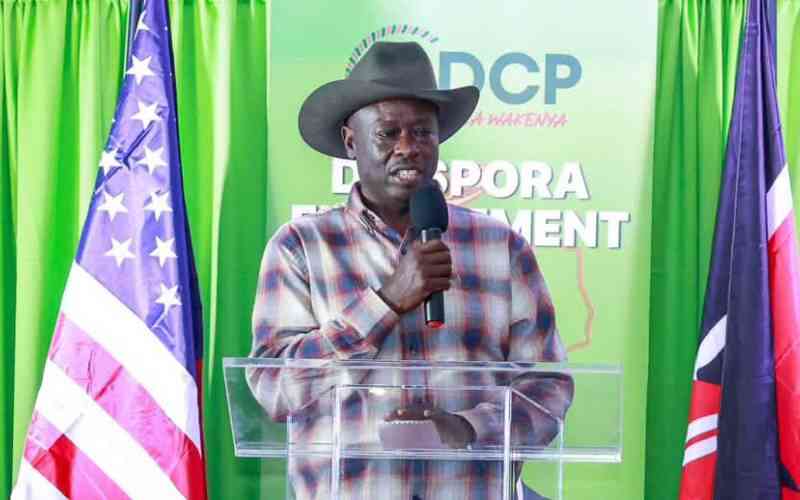
Rigathi Gachagua is saying out loud what everyone in Kenya’s opposition circles already knows but won’t admit: the united opposition is not as united as it sounds. Speaking to Kenyans in Dallas, Texas, the former Deputy President and Democracy for the Citizens Party (DCP) leader dropped a pointed accusation against his own coalition partners — that some of them are too slippery to commit publicly to backing a single presidential candidate. This is not a minor internal squabble. This is the foundational tension that could unravel everything before 2027 even arrives.
Here is what makes Gachagua’s frustration credible. He has already made his own pledge — publicly, on record — that if the opposition settles on a candidate who is not him, he will support that person. That is a real commitment with real political cost. What he is now demanding is that his colleagues do the same, and they haven’t. Instead, he says, some of their supporters are floating a deeply troubling alternative: that if their preferred candidate doesn’t get the opposition ticket, they will simply vote for President William Ruto. Let that sink in. The very people claiming to oppose Ruto are hedging their bets by keeping Ruto as a backup plan.
“That rider that if it is not our candidate then it is Ruto, then I don’t think you are genuine that we should get a single presidential candidate,” Gachagua said bluntly. He is right. You cannot simultaneously claim to be building an alternative to the status quo and treat the status quo as your Plan B. It is politically incoherent, and it signals to ordinary Kenyans — who have been burned by opposition unity deals before — that this coalition may be more about elite positioning than genuine democratic change.
Why does a public pledge actually matter here?
Gachagua’s insistence on a formal, public declaration from every opposition aspirant is not just political theatre. It is a mechanism for accountability, and a smart one. When a leader makes a commitment privately inside a coalition boardroom, there are no consequences for walking it back. But when that same commitment is made in front of millions of Kenyans — on camera, on record — the political cost of betrayal becomes real. The people, as Gachagua put it, “will come for you.” That is how coalitions hold together under pressure, not through handshakes and press conferences, but through leaders who have publicly staked their credibility on a shared outcome.
What Gachagua is essentially exposing is a culture of strategic ambiguity that has plagued Kenyan opposition politics for decades. Leaders join coalitions, make vague noises about unity, and then quietly preserve their own exit routes. The 2022 election cycle showed exactly how that plays out — promises of solidarity dissolving into individual deal-making the moment power was on the table. Young Kenyans who turned out in massive numbers that year and watched the political class manoeuvre around their votes have every reason to be sceptical of the current unity narrative. Gachagua’s challenge to his colleagues is, at minimum, an attempt to close some of those escape routes before it’s too late.
On the question of electoral integrity, Gachagua also struck a notably confident tone, arguing that the current system of counting votes at polling stations makes large-scale manipulation significantly harder than it was under the old system of transporting ballot boxes to county headquarters. He pointed to two landmark legal rulings — the Supreme Court’s 2013 decision and a more recent ruling this week — establishing that results declared at the polling station and constituency levels are final and cannot be altered upstream. Whether you trust that assurance or not depends on how much faith you have left in Kenya’s institutions, but it is worth noting that Gachagua is making a structural argument, not just a hopeful one.
The real question hanging over all of this is whether the opposition can discipline itself enough to make a unity deal mean something. Gachagua has put his commitment on the table. The ball is now in his colleagues’ court — and how they respond will tell Kenyans everything they need to know about whether this coalition is built to win or built to collapse.