Former President Uhuru Kenyatta has made a claim that cuts right to the bone of Kenyan political life: that Raila Odinga actually won the 2022 presidential election. For a man who stood beside William Ruto for a decade, who built the Jubilee coalition on a handshake and a promise, this is not a casual statement. It is a grenade rolled slowly into the room. And the question every politically conscious Kenyan under 40 is now asking is simple and brutal: if Uhuru believed Raila won, why did he hand power to Ruto without a fight?
To understand the weight of this moment, you have to place it in context. Uhuru did not make this declaration in a press conference or a prime-time interview. He moved from a quiet, almost private prayer at a graveside to a public sentence about the election outcome, and those closest to Raila read those two gestures together as a deliberate signal. The timing matters. The setting matters. In Kenyan politics, what is left unsaid is often louder than the statement itself, and Uhuru knows this better than most.
What was Uhuru’s actual role when the results came in?
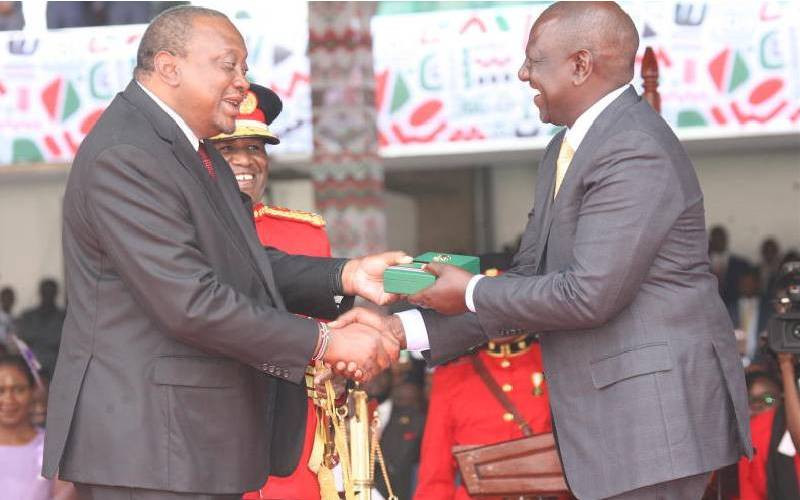
When the Independent Electoral and Boundaries Commission declared Ruto the winner in August 2022, Uhuru was conspicuously silent. He had publicly campaigned for Raila, broken with his deputy in a very public and bitter fallout, and staked his political legacy on an Azimio victory. Yet when IEBC chairman Wafula Chebukati read those numbers at Bomas of Kenya, Uhuru did not contest them. He did not stand in a court of law. He did not rally Raila’s supporters to reject the outcome. He stepped aside. The transition happened. Ruto was sworn in. Power moved.
That silence has always demanded an explanation. Raila’s own legal challenge at the Supreme Court failed, and the bench upheld Ruto’s win. But the political reading among Odinga loyalists was never fully settled. Many believed the result was engineered, that the four dissenting commissioners who walked out of Bomas before the announcement were telling the real story. Uhuru’s recent statement lands directly into that unresolved wound, reopening it with fresh force at a moment when Ruto’s government is under serious pressure from a restless, GenZ-led public that already dismantled one finance bill and has its eyes firmly on State House.
The political calculation behind Uhuru’s words is worth examining honestly. He is not a neutral observer making a historical correction. He is a former president with his own legal troubles, allies under pressure, and a complicated relationship with the current administration. Speaking now, when Ruto is politically weakened and Raila is navigating his post-AU Commission bid, serves specific interests. That does not make the claim false. It does make it strategic. Young Kenyans who watched 2022 unfold on their phones, who saw the commissioner walkout live, who have since watched the cost of living crush their futures under a government they never trusted, deserve to sit with that complexity rather than accept any single narrative at face value.
What Uhuru’s statement ultimately does is confirm what many already suspected: that the men at the top of Kenyan politics treat elections as instruments of negotiation, not expressions of popular will. Whether Raila truly won, whether the numbers were manipulated, whether Uhuru is telling the full truth or a convenient partial truth, the deeper scandal is that ordinary Kenyans were never the primary audience for any of it. The real conversation, then and now, happens between powerful men in rooms that the rest of us are not invited into. That is the story. That has always been the story.