Picture a room in Toronto, Canada. Legal scholars and political thinkers sit around a table, debating the architecture of global justice. Among them is Makau Mutua — SUNY Distinguished Professor, international law heavyweight, and a man who has spent decades watching the world’s most powerful institution slowly hollow itself out from the inside. When his turn comes to speak, he doesn’t hedge. He doesn’t soften it for the room. The post-1945 global order, he says flatly, is obsolete.
That word lands differently when you hear it from someone who has studied international law at the highest levels — not a Twitter provocateur, not a populist politician chasing applause, but a scholar who has operated inside the very system he is now declaring dead. And if you are young, Kenyan, and even mildly paying attention to how global power actually works, his argument should stop you cold.
The United Nations was supposed to be the miracle that rose from the wreckage of World War II. For the first time in history, small states and large ones, powerful and powerless, sat at the same table — each carrying a single, equally weighted vote. Africa had a seat. Asia had a seat. Latin America had a seat. It looked, on paper, like the world had finally agreed to govern itself with something resembling fairness. It wasn’t.
The system was rigged at birth.
The UN Security Council’s five permanent members — the P5 — hold veto power that no vote, no resolution, no moral argument can override. Those five countries are the United States, the United Kingdom, France, Russia, and China. Four of them are majority white and Western. Not a single African nation sits among them. Not India, with its 1.4 billion people. Not Brazil. Not one Arab state. The demographics of global power, as enshrined in the UN’s founding charter, look almost exactly like a 1945 colonial map — and almost nothing has changed since.
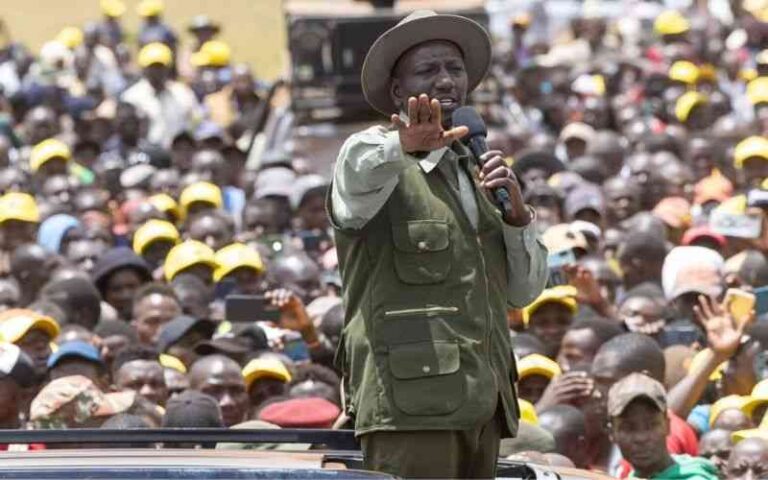
Even Kenya’s own President William Ruto stood at the G7 Summit this year and said the UN was no longer “fit for purpose.” That is a sitting African head of state, at the table of the world’s wealthiest nations, saying out loud what many have whispered for decades. It matters that he said it. It matters more that it changed nothing.
Mutua’s argument cuts deeper than institutional reform talk. He is not asking for Africa to get a permanent seat, though it should. He is saying the entire normative framework — the legal, political, and economic structure the West built after WWII — has entered what he calls “irreversible fatigue.” The norms that underpin the system no longer have the imaginative capacity to generate what he calls “global happiness.” That phrase sounds soft. It isn’t. He means the system cannot produce justice, cannot resolve conflict, cannot redistribute power, and cannot hold the powerful accountable. Look at Gaza. Look at Sudan. Look at the Democratic Republic of Congo. The UN watches. The P5 veto. The killing continues.
This is the world young Kenyans are inheriting.
A generation that grew up being told that multilateralism and international institutions were the answer — that if you followed the rules, the rules would protect you — is now watching those institutions fail in real time, on their phones, in high definition. The UN did not stop the wars. It did not stop the debt traps. It did not stop the climate negotiations from stalling year after year while the Global South burns. What it did do was give the architects of those crises a permanent veto over any serious attempt to fix them.
Mutua does not offer a tidy solution, and you should be suspicious of anyone who does. What he offers is clarity — the kind that comes from refusing to pretend a broken institution is merely “in need of reform.” The United Nations, as currently constituted, is not a neutral arbiter of global affairs. It is a monument to the power arrangements of 1945, dressed up in the language of universalism, staffed by bureaucrats, and paralysed by the interests of five countries that no longer represent the world’s largest majorities.
He is right. It is totally irrelevant.
The harder question — the one that keeps this from being merely an academic argument — is what comes next. Because if the UN is dead, the vacuum it leaves will not be filled by justice. It will be filled by whoever moves fastest. And historically, that has never been Africa. The continent that was excluded from the original table now faces the collapse of that table with no clear alternative architecture to replace it. Young, politically engaged Kenyans should feel the weight of that. Not as spectators. As people with a direct stake in what gets built next — or what gets lost in the wreckage.