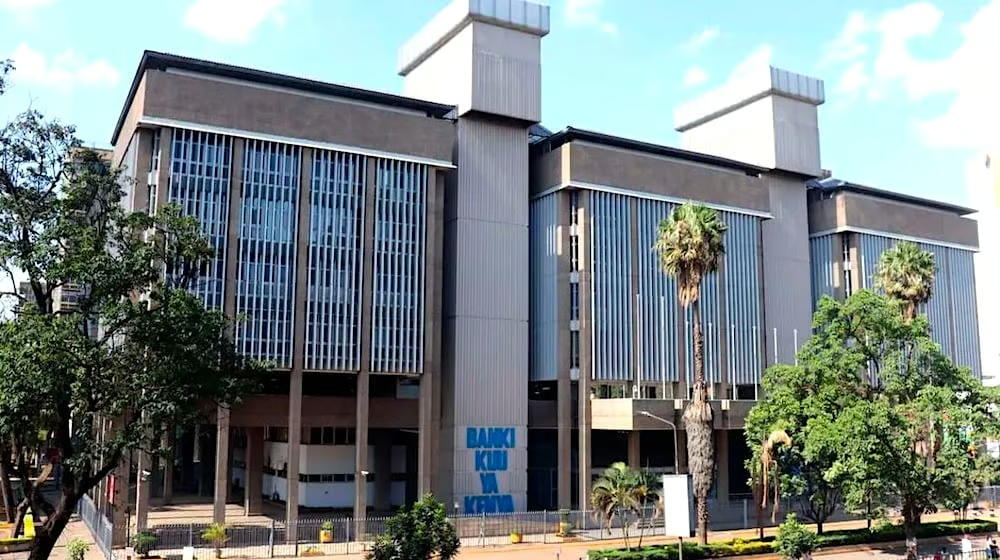

So the US Embassy is shutting its doors. Why should you care?
If you had plans to visit the United States Embassy in Nairobi on Monday, October 12, cancel them now. The embassy will be closed to the public for Columbus Day, a US federal holiday observed every second Monday of October. No consular services. No official business. Nothing.
For Kenyans chasing visa appointments, emergency travel documents, or any kind of official assistance from the mission, this is a real disruption. Plan around it, check the embassy’s official communication channels for appointment updates, and don’t show up expecting to be helped.
What even is Columbus Day?
Columbus Day commemorates Christopher Columbus’s 1492 voyage across the Atlantic, the one that landed him on islands in what is now the Bahamas. The United States has observed it annually since the early 20th century, and it carries the full weight of a federal holiday — meaning government offices, including embassies abroad, shut down entirely.
On the surface, it looks like routine administrative business. But this is where it gets complicated, and where you should stop taking the official narrative at face value.
Why is Trump making this political?
In a proclamation dated October 7, President Donald Trump didn’t just acknowledge the holiday — he weaponised it. He directed that the US flag be displayed on all public buildings and called on Americans to mark the day with “appropriate ceremonies and activities.” Standard enough. But then came the rhetoric.
“Today, we reaffirm that Christopher Columbus is a legend whose vision, fortitude, and perseverance unleashed a dynamic of history that led to the creation of the greatest, freest, and most just Nation in history,” Trump declared. He went further, vowing that Columbus’s legacy would never be “erased by radical extremists.”
This isn’t just nostalgia. It is a deliberate political signal, a pushback against the growing movement across American cities and universities that has reframed Columbus not as a hero but as the architect of colonisation, forced displacement, and the decimation of indigenous peoples. Trump is choosing a side loudly.
Why does any of this matter to young Kenyans?
Think about it. Kenya itself carries the deep scars of colonisation. The idea that a foreign government would close its embassy here to celebrate a man widely associated with the opening chapter of colonial conquest in the Americas is not a neutral act — it is layered with historical irony that demands your attention.
The debate over Columbus is fundamentally a debate about whose history gets honoured, whose pain gets erased, and who controls the official story. Those are not American questions. They are universal ones, and Kenyans, of all people, understand what it means to live in the long shadow of someone else’s “discovery.”
What should you actually do right now?
If you have any pending business with the US Embassy in Nairobi, act before Monday or wait until Tuesday. The embassy has advised the public to monitor its official communication channels for any updates related to appointments and services affected by the closure.
Beyond the logistics, stay curious about the politics wrapped inside this announcement. When powerful governments celebrate their histories, they are always telling you something about how they see themselves — and how they expect the rest of the world to see them too. Don’t just take the holiday at face value. Read between the lines.