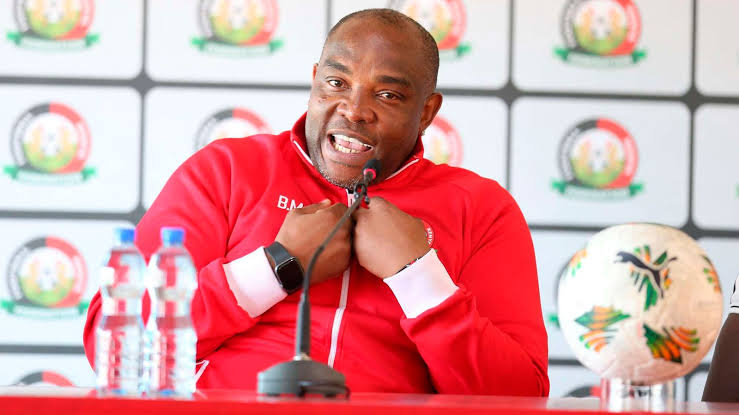
Let’s be honest about what happened in Conakry on Thursday night. Kenya’s Harambee Stars lost 1-0 to Guinea in a 2027 Africa Cup of Nations qualifier, and head coach Benni McCarthy is not staying quiet about it. He shouldn’t. Because if you watched that match with clear eyes, you already know that the referee handed Guinea something they didn’t fully earn — and that matters, especially for a young Kenyan squad fighting to prove it belongs on the continental stage.
McCarthy’s thesis was simple and direct: the referee had a poor game, the officiating was one-sided, and the goal that decided everything should never have stood. “He was looking at the foul, but he just completely ignored it, and allowed the goal to stand,” McCarthy said after the match. He went further, pointing out that in countries with stronger football infrastructure — South Africa, Morocco, Egypt — VAR would have caught it. At a higher level, he argued, the goal gets disallowed. That’s not a sore loser talking. That’s a coach naming a structural inequality that African football has refused to fix, and it’s a conversation Kenya’s football faithful deserve to have without the usual diplomatic cushioning.
The Referee Problem Is Bigger Than One Bad Call
Borussia Dortmund striker Serhou Guirassy scored the only goal in the 32nd minute, and Guinea celebrated a result that pushed them to three points and second place in Group D. But the absence of VAR in this qualifying environment is not a minor footnote — it is a recurring wound. When McCarthy says that the same goal would have been disallowed in a more developed football context, he is pointing at a system that consistently disadvantages teams from smaller football economies. Kenya, still building its international credibility, cannot afford to absorb bad decisions and simply move on. Every point in this group matters, and a stolen result early in a campaign can define everything that follows.
What makes McCarthy’s frustration sharper is that Kenya actually played well enough to deserve something from this game. The Harambee Stars created genuine chances, unsettled a Guinea side that had just been beaten 2-1 by South Africa, and refused to be the pushover many expected. “People expected us to lose by three, four or five goals,” McCarthy said, “but Guinea were very fortunate that we didn’t make use of the opportunities we created.” That is not spin. That is a coach who watched his side compete and then watched a referee help tip the scales. The experience gap in the final third hurt Kenya, no question — but experience can be built. Incompetent officiating going unchecked is a different kind of obstacle entirely.
Kenya now sits on one point after two matches, following their opening 1-1 draw with Eritrea. South Africa, led by Pitso Mosimane, are running away with Group D — six points from six, after dismantling Eritrea 5-0 following that earlier win over Guinea. The table is harsh and the math is already tight. But here is what Kenya’s young, politically conscious football community should take from this moment: Benni McCarthy refusing to absorb injustice quietly is exactly the posture a national team coach needs. Silence would have been easier. Calling out arrogance in officiating, on record, in a hostile away environment, takes something. The Harambee Stars didn’t get the result. But they showed up — and their coach is making sure the world knows the full story of why they didn’t win.