
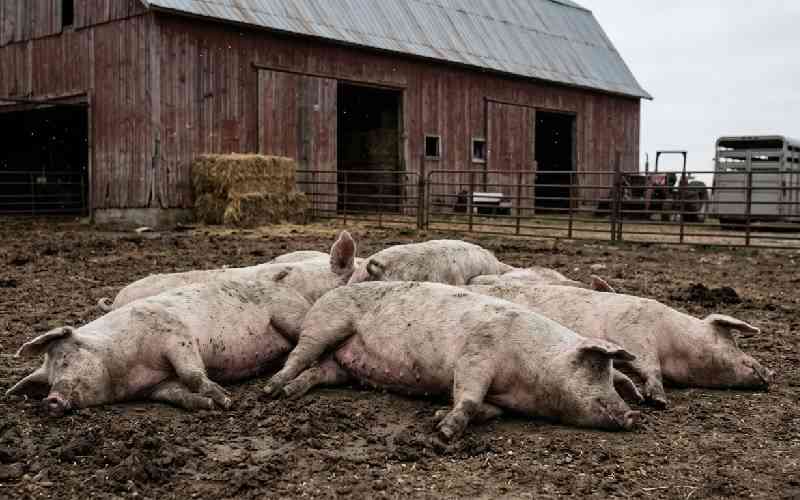
Since mid-May 2026, African Swine Fever has torn through Kiambu County’s pig farms with devastating speed, killing more than 1,470 animals across over 20 farms. If you think this is just a farming story, think again — this outbreak strikes at a sector worth Sh19.5 billion annually, and the government’s response so far raises more questions than it answers.
The Scale of the Crisis
The outbreak is not contained to Kiambu. According to the Department of Veterinary Services, six additional counties — Tharaka-Nithi, Busia, Embu, Kakamega, Homa Bay and Migori — have all reported significant African Swine Fever (ASF) outbreaks, painting a picture of a disease spreading far faster than official reassurances suggest. In Tharaka-Nithi alone, authorities recorded 108 cases and 97 deaths in a single week between January 5 and 11, 2026, a figure that should have triggered alarm bells long before the Kiambu numbers exploded. The Ministry of Interior and National Administration disclosed these details during a meeting of the Border Control and Operations Coordination Committee, chaired by Internal Security Principal Secretary Raymond Omollo — a bureaucratic setting that itself tells you something about how the state frames this crisis: as a security and border problem, not primarily a livelihood emergency for ordinary Kenyan farmers.
What ASF Actually Does — And Why It Matters to You
African Swine Fever is a highly contagious viral disease that targets domestic and wild pigs with lethal efficiency, and there is currently no widely available commercial vaccine or effective treatment for the strains circulating in Kenya. The virus spreads through direct contact with infected animals, contaminated pork products, equipment, vehicles and even people who have handled infected stock, making containment extraordinarily difficult once it takes hold in a dense farming area. It does not infect humans — this is not a public health emergency in the conventional sense — but the economic devastation it leaves behind is entirely real, felt most acutely by small-scale pig farmers who have little cushion against sudden, total herd loss. Kenya has lived with this disease for over a century, with outbreaks documented as far back as the early 1900s, yet the country still has no reliable vaccine programme and no effective treatment protocol in place.
A Sector Already on Its Knees
The pig sector was struggling before this outbreak arrived. High feed costs and chronic weaknesses in traceability and cold-chain infrastructure had already been eating into margins, and the sector’s contribution of roughly five per cent of total livestock output — significant by any measure — was under pressure even in a good year. The government speaks ambitiously about expanding pig farming as an economic driver, but the structural investments needed to make that vision real have been slow, uneven and persistently underfunded. What ASF does, in this context, is not merely kill pigs — it destroys the livelihoods of farmers who have invested everything into a sector the state claims to value but has repeatedly failed to adequately protect.
The Government’s Response: Surveillance, Protocols and a €47 Million Programme
Authorities say they have intensified disease surveillance, increased movement controls for livestock and pastoralist communities near borders, and are monitoring cross-border transmission risks through the IGAD Protocol on Transhumance — a regional framework governing the seasonal movement of pastoralists across three clusters linking Kenya to Ethiopia, Somalia, Uganda, South Sudan and Tanzania. Vaccination campaigns against other livestock diseases, deworming and pest control are also underway. The government is additionally implementing a €47 million (approximately Sh7 billion) Pastoralism and Livestock Adaptation to Climate in Eastern Africa programme, funded by the Food and Agriculture Organization and the European Union, aimed at strengthening livestock systems and supporting pastoralist livelihoods. These are not trivial interventions, and it would be dishonest to dismiss them entirely — but none of them directly address the absence of an ASF vaccine, and none of them bring back the 1,470 pigs already dead in Kiambu.
Key Facts You Need to Hold Onto
The hard truth is this: until Kenya invests seriously in ASF-specific research, farmer compensation mechanisms and rapid-response infrastructure that reaches small-scale pig farmers before their entire herds are gone, these outbreaks will keep happening, the death tolls will keep rising, and the government’s border meetings will keep producing statements that sound decisive but change very little on the ground. Kenyan pig farmers deserve better than that — and so does the sector the state keeps promising to build.