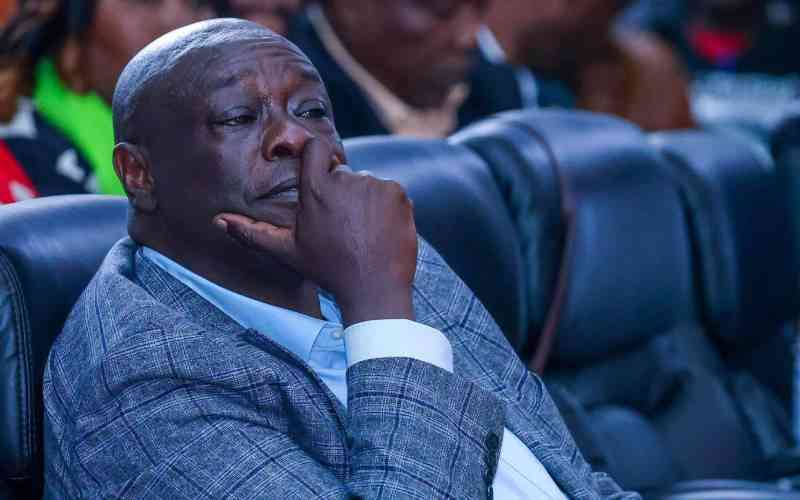
Picture this: a former Deputy President, impeached and cast aside, standing in a church in Gatundu South on a Sunday morning, looking straight into the camera and telling William Ruto that the opposition doesn’t need a single shilling from Uhuru Kenyatta to end his presidency. That is exactly what Rigathi Gachagua did on August 16, 2026, at PCEA Rev. Samuel Marima Memorial Church in Kiambu County — and if you think that moment was just political theatre, you are not paying attention.
The Ruto administration has been floating a convenient narrative: that the growing opposition wave threatening Kenya Kwanza ahead of the 2027 General Election is not organic, not real, not driven by genuine public anger — but rather bankrolled by a bitter former president with deep pockets and a grudge. It is the kind of story that powerful governments tell when they cannot explain away mass discontent. Gachagua walked into that church and dismantled it, sentence by sentence.
“Nasikia kwamba Uhuru is sponsoring us to campaign against you. Uhuru is not sponsoring us, we don’t need any sponsorship, this is a mass movement for change which does not need funding,” he said. There is no ambiguity there. No diplomatic softening. Just a direct rebuttal aimed at anyone still willing to give the government’s spin the benefit of the doubt.
And then he went further — because Gachagua always goes further. He drew a clear line between Kenyatta the retired elder statesman and himself as the active political challenger. “Nimemwambia Ruto unauliza Uhuru nini na sio candidate in the next election. I am your main opponent.” That single declaration reshuffles the entire political chessboard. Gachagua is not positioning himself as a proxy or a messenger. He is the fight. He is placing himself front and centre of a 2027 contest that is shaping up to be one of the most consequential in Kenya’s post-independence history.
He also defended Kenyatta with a firmness that felt almost protective. “Uhuru Kenyatta asiguzwe na mtu yeyote. Alindwe na atetewe na apatiwe amani. Uhuru alifanya kazi yake na akastaafu.” Leave the man alone. He did his job. He retired. It reads like a warning — stop using Kenyatta as a political punching bag when the real contest is between Gachagua and Ruto.
But the moment that should stay with every young Kenyan struggling to make rent, buy unga, or keep a small business alive came when Gachagua turned his attention to Treasury Cabinet Secretary John Mbadi’s jaw-dropping claim that rising soft drink consumption signals improved household incomes. Let that sink in. The government’s measure of your economic wellbeing is whether you are buying more Coca-Cola. Gachagua’s counter-metric was blunt and brilliant: “If you want to know if the economy is doing well, ask the pastor about the offering; it will tell you how the economy is moving.” Church offerings do not lie. When people have money, they give. When they are broke, they do not — no matter how much they want to. That is the kind of economic analysis that resonates in a country where official statistics and lived reality have never felt further apart.
This is the political moment Kenya is in right now. The cost of living is crushing ordinary families. The government’s credibility on economic management is in freefall. And the opposition, rather than waiting for a billionaire patron to fund their campaign, is betting on something far more dangerous to any sitting administration — genuine, widespread, unfunded public fury.
“We don’t need money but Kenyans will send you home,” Gachagua said. Short. Sharp. Absolute.
Whether you trust Gachagua — a man who was himself part of the Kenya Kwanza project before being unceremoniously removed — is a fair question to sit with. His record is not spotless. His ambitions are obvious. But the argument he is making transcends his personal political journey: that a government which has failed its people does not get to hide behind conspiracy theories about opposition funding. Kenyans are angry on their own. They do not need to be paid to feel it. And if 2027 plays out the way the current political temperature suggests, that anger may well be the only currency that matters.