
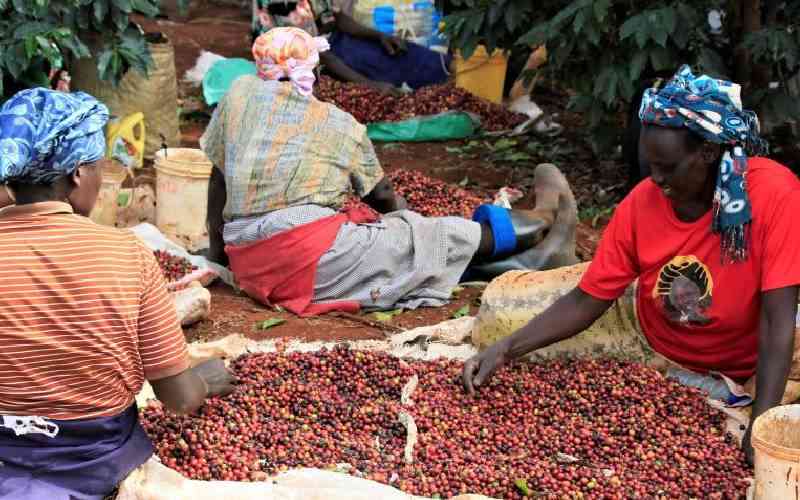
Kenya’s coffee sector just posted its best numbers in years. Sh41 billion. Forty-seven million kilogrammes. A 15 percent jump from the previous year’s Sh35.6 billion. On paper, this looks like a win. But if you’re a smallholder farmer in Meru or Murang’a, staring at your share of that figure, you already know the gap between what the sector earns and what actually lands in your pocket is the real story here.
The central thesis is this: the Nairobi Coffee Exchange’s 2025/2026 numbers reveal a structurally productive sector that continues to concentrate its gains at the top of the value chain, not at the farm level where the labour actually happens. The data confirms growth. It does not confirm equity.
Start with the broker dominance. In the trading period running from October 1, 2025 to September 30, 2026, eighteen brokers participated in the auction of 770,034 bags. Two of them — Alliance Berries Limited and New KPCU — controlled 61 percent of everything traded. Alliance Berries alone moved 222,329 bags, commanding 29 percent of total production. NCE Chief Executive Lisper Ndung’u confirmed these figures without apparent alarm. That concentration of market power in two firms is not a footnote. It is the architecture of the system.
Then look at what the cooperative unions — the structures that are supposed to protect smallholder farmers — actually earned. Meru marketed 21,786 bags and netted Sh23.8 million. Mt Elgon moved 15,334 bags for Sh17.9 million. Murang’a brought in 12,476 bags worth Sh13.3 million. These are the people growing Kenya’s internationally celebrated AA-grade beans. Their combined earnings from this data barely register against the Sh41 billion headline. The math is not flattering to the system.
Coffee Board of Kenya Chairman Henry Kinyua urged farmers to “follow the laid-down farming practices” and promised improved prices in 2026/2027. That kind of language — passive, institutional, top-down — is exactly what skeptical young Kenyans should interrogate. Who designed those practices? Who benefits most when farmers comply? Promises of better prices next year have been the perennial carrot dangled before Kenyan coffee growers for decades.
None of this erases the fact that Sh41 billion is real money moving through a sector that employs hundreds of thousands of Kenyans. Growth matters. But growth that consistently rewards brokers and exchanges more visibly than it rewards the farmers carrying the harvest is not progress — it is the same old system running slightly faster. The numbers are better. The structure is unchanged. That distinction is everything.