A man is dead. Nine motorcycles are ash. A police vehicle is wrecked. And two competing narratives about what happened this weekend are now circling each other like fighters before a brawl. The thesis here is simple and uncomfortable: Kenya’s political class is weaponising ordinary citizens, and the truth about what happened in Kisumu and Nyahururu is being buried under spin from every direction.
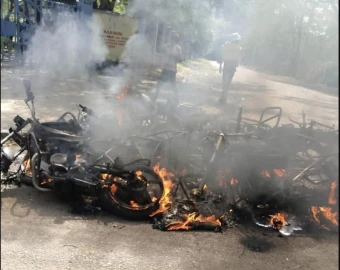
At ACK Cathedral in Kisumu, a sacred space became a battleground. One group arrived with the explicit intention of interrupting an ongoing church service — a service attended by Linda Mwananchi leaders James Orengo and Edwin Sifuna. Another group came out to block them. What followed left one person dead, several others injured, nine motorcycles torched and a police vehicle damaged. This was not a spontaneous eruption of civic frustration. This was organised.
The National Police Service (NPS) confirmed the death and the destruction in a Sunday evening statement, announcing that eight suspects had been arrested pending arraignment. Spokesperson Muchiri Nyaga framed it as a swift, contained response. But no amount of clean official language changes the fact that someone lost their life outside a church because political operatives decided a Sunday service was the right venue for a confrontation.
Meanwhile, in Nyahururu, Murang’a Governor Irungu Kang’ata claimed his bodyguard was shot when their Linda Mwananchi rally was disrupted. The police flatly denied it. According to NPS, what actually happened was a stone-throwing incident that left one Joseph Gitau with a chest injury — treated and discharged. Six suspects were arrested. No shooting, said Nyaga. No gun. Kang’ata says otherwise. Somebody is lying, and young Kenyans who have watched this political theatre for years already know that the truth usually lives somewhere neither side wants to go.
Here is what both incidents share: ordinary people absorbing the physical consequences of elite political rivalries. The man dead in Kisumu did not draft the Linda Mwananchi agenda. Joseph Gitau in Nyahururu did not write anyone’s manifesto. Yet they — and dozens of others injured across both scenes — paid the price for conflicts engineered by people who will sleep safely tonight behind guarded gates.
The NPS warning that followed was pointed and necessary, stating that “no person — regardless of social status, political affiliation or public office — is above the law” and that anyone “sponsoring criminal gangs, inciting supporters or disrupting lawful gatherings” will face consequences. Strong words. The question every skeptical Kenyan is already asking is whether those words will ever produce a single conviction against someone who actually matters politically, or whether the six suspects in Nyahururu and the eight in Kisumu will simply be the fall guys while the organisers walk free.
Political violence in Kenya does not happen in a vacuum. It is funded, coordinated and given plausible deniability by people who never throw a single stone themselves. Until accountability reaches that tier — the sponsors, not just the foot soldiers — the warnings from NPS are noise. The implication is stark: if this weekend’s bloodshed produces no meaningful prosecution of those who ordered the disruptions, then the next rally, the next church service, the next public gathering becomes a potential crime scene. Kenya deserves better than that cycle, and its young people are watching closely enough to know exactly who is responsible.