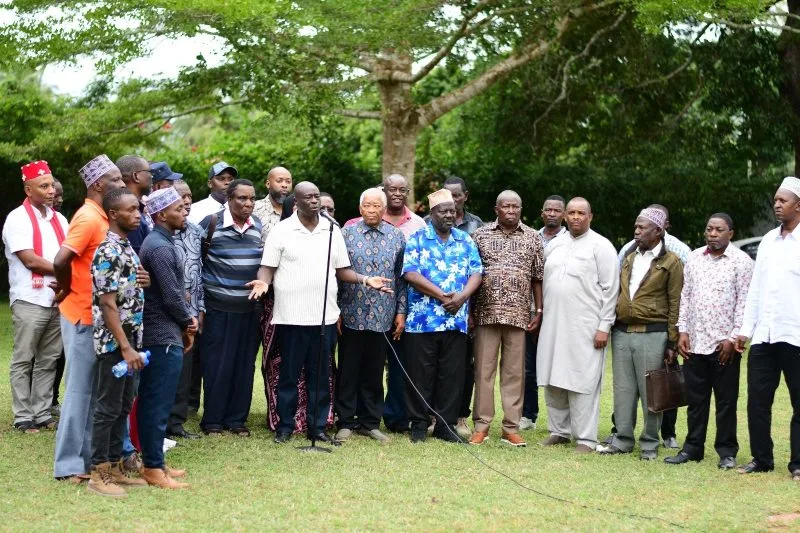
It started with a break in routine. Rigathi Gachagua had been deep in his 45-day political consultation retreat at his Wamunyoro residence — a deliberate, calculated withdrawal from public life — when the call came from the Coast. Leaders of the Mijikenda community needed him present. He packed up and went.
The meeting, convened under the leadership of spokesman Hon. Chirau Ali Makwere, pulled together representatives from all nine Mijikenda sub-communities: the Digo, Giriama, Duruma, Rabai, Chonyi, Kauma, Kambe, Jibana, and Ribe. This was not a courtesy visit. This was a political signal — and Gachagua knew exactly what he was walking into.
What the Coast leaders laid on the table was a catalogue of grievances that should make every Kenyan pay attention. According to Gachagua, the communities raised concerns about economic exclusion from their own region, the hemorrhaging of local jobs, disputed land rights, and the exploitation of mineral resources with nothing trickling back to the people who live on top of them.
Then came the sharpest accusation of the day. Gachagua declared that the Port of Mombasa — the economic heartbeat of the entire East African coast — is being handed over to foreigners, top political insiders, and what he called “the oligarchy.” His words were blunt: “My cousins from Coast are a community in distress.” That is not the language of a politician hedging his bets. That is someone throwing down a gauntlet.
He went further. Gachagua directly accused President William Ruto’s administration of concentrating government appointments and economic opportunities among individuals tied to Ruto’s inner circle, effectively locking out Coast communities from the national table. He alleged that dissent in the region was being actively suppressed — that people who speak up face consequences.
The most explosive charge came last. Gachagua alleged that senior government officials are protecting drug trafficking networks operating along the Coast — networks that have devastated a generation of young people in the region. He connected the dots between political impunity, narcotics, and the insecurity that has hollowed out communities from Mombasa to Kilifi.
By the time the meeting closed, Gachagua had pledged full political solidarity with Coast leaders and framed the entire struggle in terms that go far beyond regional politics. He called it national liberation — a project he says will unite communities from across Kenya. Whether you trust him or not, one thing is clear: Gachagua is building something, and he has chosen the Coast as his next front.