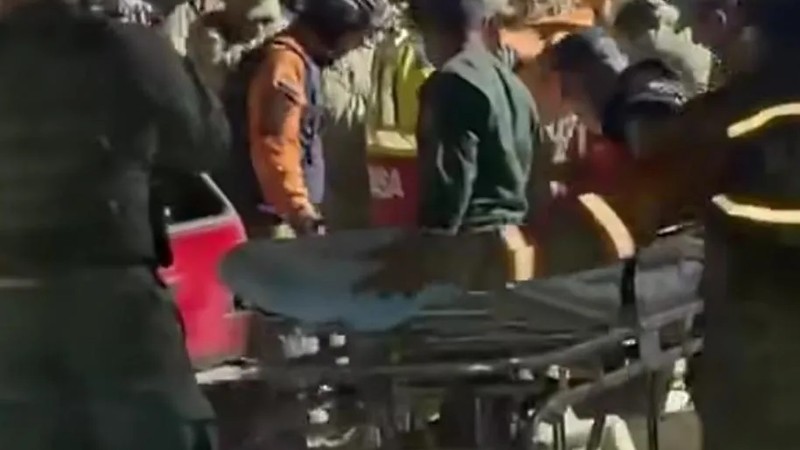
An 11-year-old boy named Moisés was pulled from the rubble of La Guaira, Venezuela, more than three days after twin earthquakes tore through the country. His mother and sister did not make it. He did — with a broken arm, on a stretcher, blinking into daylight after spending over 72 hours trapped roughly ten feet beneath collapsed concrete.
It started on a Wednesday. Two earthquakes struck Venezuela in quick succession, triggering what experts call a “pancake collapse” — floors stacking onto floors, crushing everything between them. Rescue workers describe it as one of the most brutal structural failures to navigate. The weight is immense. The gaps are small. And time is the cruelest variable of all.
The 72-hour golden window — the period after a disaster when survival rates drop sharply — was already closing when Colombian search and rescue team USAR COL-1 picked up Moisés on their scanner. They worked six hours straight to reach him. Six hours of careful, exhausting precision while a child waited in the dark.
By the time rescuers extracted him on Saturday, Venezuela’s National Assembly President Jorge Rodríguez had confirmed a death toll of at least 1,430 people. At least 3,238 others were injured. Some 3,142 families had lost their homes entirely. These are not abstract numbers — they are neighbourhoods erased.
Acting President Delcy Rodríguez announced that 24 countries had dispatched aid and 2,741 rescuers to the country. The United Nations humanitarian affairs agency put the figure at 44 international urban search and rescue teams — 2,245 specialists and 140 search dogs deployed across the disaster zone. The international response was real. But the ground reality was harder.
Heavy machinery was scarce. Aftershocks kept rattling what little structure remained. Venezuela’s healthcare system, gutted by decades of underfunding and mismanagement, buckled under the weight of thousands of injured people flooding hospitals that were already operating on fumes. Residents — many of them still searching for family members by hand — grew visibly frustrated with the pace of operations.
Weeks of institutional neglect do not disappear in a crisis. They become the crisis.
Meanwhile, small victories kept breaking through the despair. Also on Saturday, the fire department from Quito, Ecuador, working alongside a team from El Salvador, pulled Marlene — an 80-year-old woman — from the rubble of a building in the Playa Grande area. She had been trapped for more than 60 hours. She survived.
A US official confirmed that one runway at the international airport near Caracas had been restored to operational status, clearing a critical bottleneck that had slowed the flow of incoming aid. Mobile hospitals began arriving. The US also moved to push more Starlink terminals into the country — because in a disaster of this scale, connectivity is not a luxury. It is the difference between a family knowing their person is alive and spending days in silent, suffocating uncertainty.
The European Union committed €5 million (approximately USD $5.6 million) in emergency assistance to affected communities. The money matters. But right now, in La Guaira and across the disaster zone, what matters most is the next scanner ping, the next faint voice beneath the rubble, the next Moisés.
The official narrative from Caracas will talk about coordination, international solidarity, and resilience. And some of that is true. But the families still digging through rubble with their hands know something else: the system failed long before the first tremor hit. What they are living through now is not just a natural disaster. It is the bill coming due.