Every single day, Nairobi generates 3,200 tonnes of garbage. Let that number sit with you for a moment.
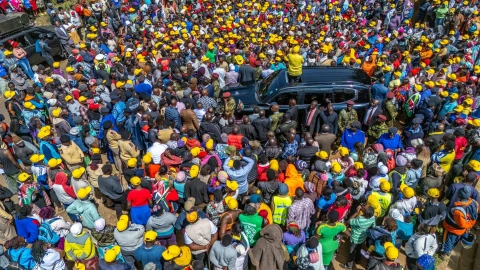
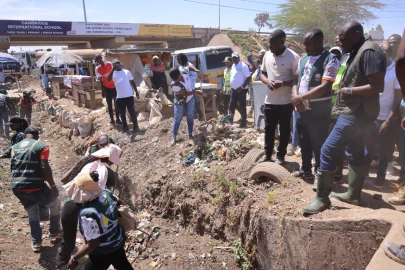
That is not a statistic buried in some government report nobody reads. That is the weight of a city slowly suffocating under its own waste — clogged drainage channels, overflowing streets, neighbourhoods that have been waiting years for someone, anyone, to show up with a truck and a plan. And now, with the October-to-February rains approaching like a deadline nobody asked for, Nairobi Governor Johnson Sakaja has taken to the streets himself, leading a citywide clean-up that has mobilised roughly 4,500 Green Army personnel alongside county staff, residents and various stakeholders to tackle the garbage choking neighbourhoods, roads, public spaces and drainage channels across the capital.
This is not just a photo opportunity. At least, it should not be. The timing is too urgent, the stakes too real for anyone with a flooded living room or a waterlogged commute to dismiss this as political theatre. Blocked drainage channels are not an inconvenience — they are the direct reason entire estates transform into swamps every time the clouds open up. The county knows this. That is precisely why the clean-up is targeting waterways first, pulling out the accumulated waste before the rains turn every blocked drain into a flooding catastrophe waiting to happen.
Sakaja’s message to Nairobi residents was blunt and, frankly, long overdue. He told residents, businesses and institutions to take ownership of at least 100 metres around their premises — not to wait for a county truck, not to dump quietly into the nearest channel at night, but to treat their immediate environment as their own responsibility. “Nairobi Lazima Iwork is not just about what the county government does,” he said. “It is about what each one of us does.” That is the kind of direct accountability talk that young Nairobians who have grown up watching their city decay while officials make promises deserve to hear — even if the healthy skepticism in us demands we watch whether the actions match the words.
Green Nairobi County Executive Committee Member Maureen Njeri pushed the same line, calling for a cultural shift away from a city that outsources its cleanliness entirely to the county government. “Green Nairobi belongs to all of us,” she said, “and keeping the city clean must become a shared responsibility.” The sentiment is right. The question that politically engaged Nairobians are already asking is whether the infrastructure exists to back it up — because telling residents to clean up while the systems around them remain broken is just blame-shifting dressed in civic language.
That is where the structural ambitions of this campaign become important to track. The county is not just organising clean-up days — it is advancing plans to establish NCCG-Green Nairobi Limited Company, a county-owned entity that would take formal charge of waste-management operations across the city. A seven-member board was formally inducted in September, chaired by environmentalist Dr Isaac Kalua, and gazetted on August 14, 2026, for a three-year term. The mandate is sweeping: garbage collection, licensing of waste collectors, maintenance of public spaces, and coordination of all waste-management activities. If this entity functions as designed, it represents a genuine institutional shift — moving waste management from a chaotic patchwork of contractors and county departments into a single, accountable structure.
Sakaja has also signalled a more ambitious long-term vision — one that moves Nairobi beyond the collect-and-dump model that has defined waste management here for decades, toward a system built around processing and recycling. That matters enormously in a city where landfills are running out of space and where the informal recycling economy — the chokora, the scrap dealers, the jua kali sorters — already does significant environmental work without a shred of formal recognition or support. Whether the new Green Nairobi entity will integrate these existing networks or bulldoze past them in favour of a sanitised corporate model is a question worth pressing.
For now, the immediate marker is October 10 — Mazingira Day — when Sakaja has called on residents, community groups, businesses and institutions to participate in a citywide clean-up exercise. It is a moment designed to signal that environmental stewardship is not a government department’s job alone. Whether thousands of ordinary Nairobians show up, whether the drainage channels actually stay clear after the cameras leave, whether the Green Nairobi board becomes a functioning oversight body or another gazetted ghost — that is the real story. The garbage is real. The floods are real. The 3,200 tonnes accumulating every single day are real. What remains to be proven is whether the political will is equally real, or whether Nairobi will be having this exact same conversation, knee-deep in floodwater, when the rains finally arrive.