A City Held Hostage
Picture this: it is 7:30 in the morning, your matatu has barely moved in forty-five minutes, and the driver is gripping the wheel with the quiet fury of a man who has already done the math and realised he will lose money today. Around you, a tangle of vehicles stretches from State House Road through Milimani all the way down Valley Road — a slow, exhaust-choked river of frustration converging at a single, overwhelmed junction. This is not an occasional bad day in Nairobi traffic. This is every day now, and it is getting worse.
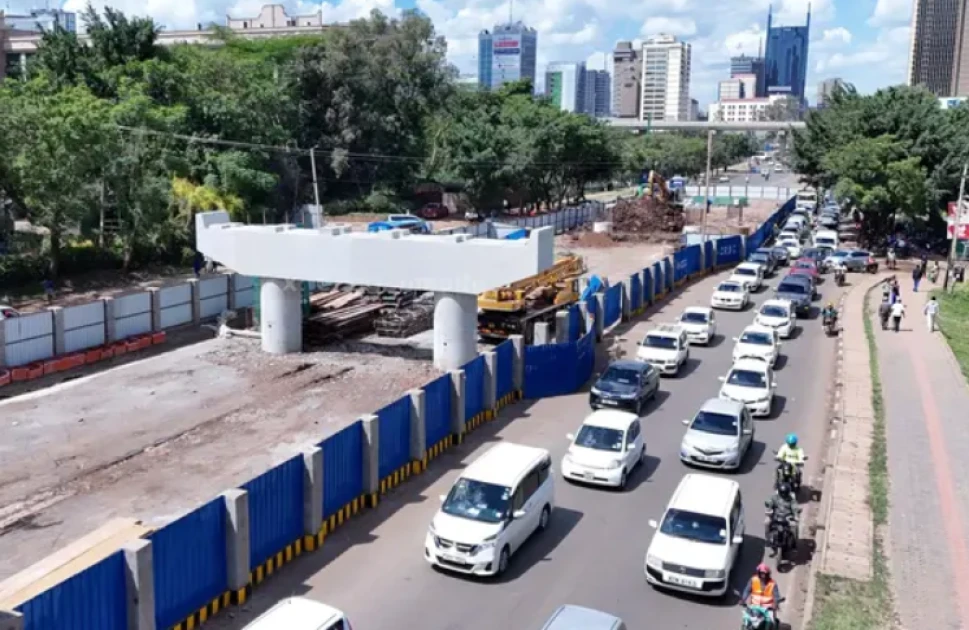
The culprit, officially at least, is progress. The Sh3 billion Upper Hill viaduct project — a flyover designed to finally untangle one of the city’s most congested corridors — has expanded its construction footprint around the Milimani area, forcing the partial closure of key lanes and compressing the daily movement of tens of thousands of road users into a bottleneck that, by any honest measure, the city was not prepared for.
The Anatomy of a Gridlock
The mechanics of the chaos are straightforward, even if the suffering it produces is anything but. The closure of additional road sections near the Milimani Law Courts and along Valley Road has effectively funnelled traffic from three major arteries — State House Road, Milimani Road and Valley Road — into a single, choking junction. There is nowhere for that volume of vehicles to go. So they sit. Morning peak hours are brutal. Evening peak hours are worse. And in between, the congestion never fully clears.
Public transport operators have been hit the hardest, and they are not shy about saying so. Drivers report spending well over an hour trapped in a stretch that should take minutes, watching fuel burn and earnings evaporate simultaneously. “We spend more than an hour here,” one driver said, his voice carrying the exhaustion of someone stating a fact he has repeated too many times. “The cars are bumper to bumper; nothing is moving. Vehicles from State House, Milimani and Valley Road all merge here, and it becomes a nightmare.” That is not hyperbole. That is a precise description of what happens when infrastructure management fails in real time.
The Boda Boda Trap
For boda boda riders and delivery operators — the people who keep this city’s informal economy breathing — the situation carries an additional, infuriating dimension. When gridlock makes the main roads impassable, the instinct is to find another way through. But in Nairobi in 2025, that instinct comes with a ten-thousand-shilling fine. Riders attempting to use alternative routes to bypass the congestion say they are being intercepted and penalised by traffic enforcement officers, leaving them caught between an immovable jam and a punishing fine. “Where are we supposed to pass when every road is congested?” one rider asked — and that question deserves an answer that no authority has yet provided.
The Promise Versus the Reality
President William Ruto announced recently that the viaduct, currently sitting at approximately 60 percent completion, will be finished and opened before December. It is a bold timeline for a project that began in September 2020, stalled for years over payment disputes, and only resumed in July 2025. The official completion date, according to the project schedule, is February 2027 — which means the December promise and the contractual reality are already in tension before a single additional beam has been laid.
Authorities insist the long-term payoff is real: once complete, the viaduct will meaningfully ease movement between Upper Hill and the CBD, two of Nairobi’s most economically dense zones. That argument is not wrong. But it is also not the argument that lands when you are a PSV operator watching your daily earnings collapse, or a delivery rider being fined for trying to do your job. The gap between the government’s long view and the road user’s immediate reality has never felt wider.
The Ripple Effect on Ngong Road
The congestion is not contained to the immediate construction zone. PSV operators warn — and commuters are already experiencing — that the spillover has reached Ngong Road, one of the city’s other critical arteries, which is now absorbing the overflow traffic and developing its own chronic delays. When one part of Nairobi’s road network seizes up, the pressure does not disappear; it redistributes. The city’s road planners either did not model this adequately, or they did and chose not to share the findings with the public. Neither possibility is reassuring.
What Road Users Are Actually Asking For
The people caught in this gridlock are not asking the government to stop building the viaduct. They understand, broadly, that the city needs better infrastructure. What they are asking for — and what they deserve — is a traffic management plan that treats their time, their livelihoods and their safety as variables worth optimising, not inconveniences to be endured. “They should not close all the lanes. They should leave at least one side open,” one PSV operator said, articulating a solution so basic it is almost painful that it requires public advocacy to surface.
One driver put it with a directness that cuts through every official statement about long-term urban development: “We are not against development, but this development is hurting us. We are losing more than we earn. The government should find a better way so that the project is completed quickly.” That is not resistance to progress. That is a citizen demanding that progress be managed competently.
The Longer Road Ahead
The Upper Hill viaduct will, eventually, be built. Whether it opens in December as the President promised, or in February 2027 as the schedule suggests, or at some point beyond that — as Nairobi’s infrastructure history would lead any sceptic to suspect — the structure will eventually span the valley and reshape movement in that part of the city. But between now and that ribbon-cutting moment, thousands of Nairobians will lose hours they cannot recover, money they cannot afford and patience they were already running short on. The question is not whether the viaduct is worth building. The question is whether the people bearing the cost of building it will ever be treated as stakeholders in that process, rather than obstacles to be routed around.
So far, the answer the city has given them is a ten-thousand-shilling fine and a traffic jam with no end in sight.