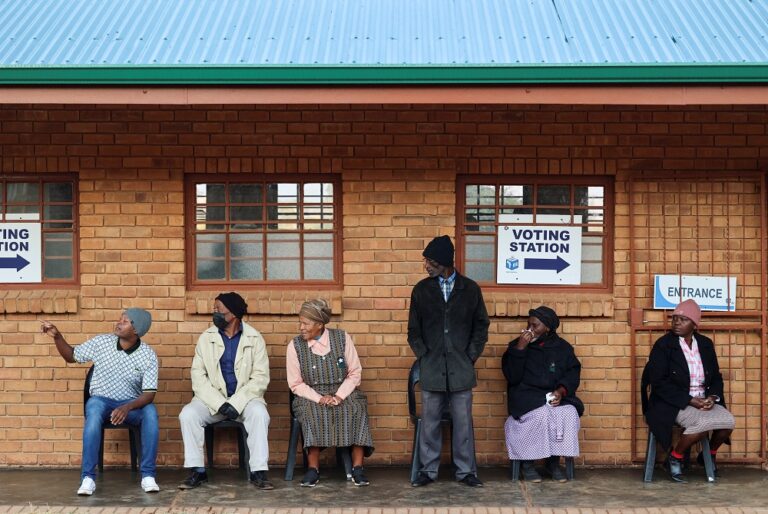

Voters Defy Chaos to Deliver a Landslide
The people of Ol Kalou spoke — loudly, clearly, and in defiance of everything thrown at them. Opposition party DCP’s Douglas Kamau Waweru won the constituency’s parliamentary by-election with 35,440 votes, crushing UDA’s Samuel Muchina Nyagah by nearly 30,000 votes in a result that sent a message no politician should ignore: Kenyans will vote even when you send armed men to stop them.
This was not a clean, textbook election. It was a battlefield. Masked, armed men stormed polling stations and forced voters to flee. Journalists covering the vote were physically attacked, had their equipment destroyed, and one female reporter was held at gunpoint while a goon snatched her phone. One person lost their life in a confrontation with security personnel. And still, voters showed up.
What Actually Happened on the Ground
The Independent Electoral and Boundaries Commission (IEBC) had projected a voter turnout of close to 50 percent — modest, but not surprising given the atmosphere of fear and intimidation that hung over the constituency. What is remarkable is that turnout held at all, considering armed hooded attackers were actively disrupting the process at polling stations.
Violence, bribery, and extortion were all deployed as tools to manipulate the outcome. None of it worked. The margin of victory — nearly 30,000 votes — is not the result of a close race decided by dirty tactics. It is a decisive rejection, a landslide that cannot be explained away or disputed.
To their credit, the losing candidates conceded quickly, sparing the constituency the drawn-out drama that has poisoned past Kenyan elections. That, at least, was a sign of political maturity.
The IEBC Delivered — But Questions Remain
The IEBC managed the voting, ballot counting, and results announcement without the process collapsing under the weight of the disruption. That matters, especially with the General Election scheduled for August 10 next year fast approaching. A credible by-election is proof of concept — evidence that Kenya’s electoral infrastructure can hold under pressure.
But the commission and the broader security apparatus cannot take a bow just yet. The hooded attackers who terrorised voters and journalists remain unidentified and, as far as the public knows, unpunished. That is unacceptable. A democracy that cannot protect the people exercising its most fundamental right is a democracy in name only.
The Real Stakes Here
Here is what this by-election actually reveals about Kenya’s political moment:
The Ol Kalou result is a victory worth celebrating, but it is not a reason to exhale. The same forces that sent masked men to polling stations are already calculating their next move. The authorities know who those attackers were — or they should. The question is whether they will act, or whether accountability will once again be the first casualty of Kenyan politics.
What Must Happen Next
Identifying and prosecuting the hooded attackers is not optional — it is the minimum standard of a functioning state. Every day they walk free is a signal to every political actor with resources and impunity that violence is still a viable electoral strategy in this country.
The IEBC must also use this by-election as a stress test, honestly assessing where the system held and where it cracked, before those cracks become craters in a general election. Ol Kalou’s voters did their part. Now the institutions need to do theirs.