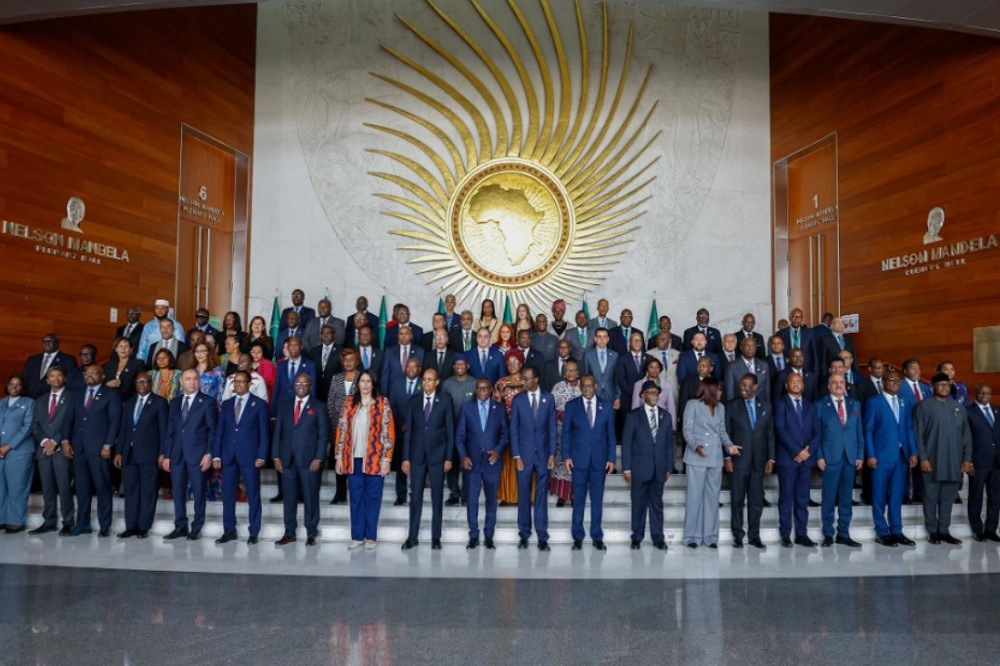
The African Union is in crisis — and not just because of the wars, disease, and terrorism eating at the continent’s edges. The deeper crisis is one of dependency, and a few voices at last week’s AU Executive Council session in Addis Ababa said it plainly.
AU Commission Chairperson Mahmoud Ali Youssouf opened the 49th Ordinary Session of the AU Executive Council with a stark assessment of where Africa stands right now. The consequences of the Middle East conflict are rippling across the continent. Terrorism is spreading through the Sahel with no sign of retreat. And in the Democratic Republic of Congo, the Ebola epidemic has already claimed more than 1,000 lives. Youssouf did not soften any of it: “Our continent is suffering fully the consequences of the crisis in the Middle East,” he told delegates, adding that the health and security emergencies compounding each other represent an existential threat to Africa’s development trajectory.
But it was Burundi’s Foreign Minister, Ambassador Edouard Bizimana, who said the quiet part loud. Africa cannot keep running to external donors every time it needs to respond to a crisis and then wonder why its decisions get shaped by outside interests. Bizimana, speaking in his capacity as Chairperson of the AU Executive Council, pushed member states to fund the AU themselves — not as an aspiration, but as a political imperative. “A strong union should be funded first by Africans themselves,” he said, and he came with receipts: Burundi has now written a 0.2% levy directly into its national budget law, in line with AU decisions on sustainable financing.
Why This Matters More Than the Speeches Suggest
If you are young, Kenyan, and paying attention, you already understand that the institutions meant to protect African interests have a funding problem that makes them structurally compromised. The AU’s heavy reliance on external contributions — from the European Union, the United States, and multilateral bodies — is not a technicality. It is a leverage point. Whoever pays the bill sets the agenda, and Africa has been living with that uncomfortable truth for decades while official communiqués talk about “partnership” and “solidarity.”
Bizimana’s point about the 0.2% levy is not glamorous, but it is concrete, and concrete matters in a space where rhetoric is abundant and accountability is scarce. The levy, agreed upon in principle by AU member states years ago, has seen painfully slow implementation. Burundi formalising it in national law is a signal — small in isolation, significant if it pressures others to follow. Kenya, for its part, has been a vocal advocate of African self-reliance on the continental stage, and the question worth asking is whether that advocacy translates into the same fiscal commitment at home.
The crises Youssouf catalogued — conflict spillover, Sahelian terrorism, Ebola in the DRC — are not abstract threats. They shape migration patterns, trade routes, public health infrastructure, and ultimately the quality of life of ordinary people from Mombasa to Dakar. A continental body that cannot fund its own emergency responses without going cap in hand to Brussels or Washington is a body that will always arrive late, always negotiate from weakness, and always compromise on the terms of its own intervention.
The 49th session will not be remembered as a turning point. But the argument being made inside that chamber in Addis Ababa — that African sovereignty is inseparable from African financial independence — is the right argument. The continent’s young, politically literate generation deserves institutions that are built to win, not just to convene.