A Saudi Arabian real estate and construction powerhouse has planted its flag inside Kenya’s most ambitious urban development, with Mabani Aljazeera Holding Group acquiring a near-equal stake in the Jabali Towers mixed-use project at Tatu City — a move that signals, loudly and unmistakably, that global capital is betting on Kenya’s future right now.
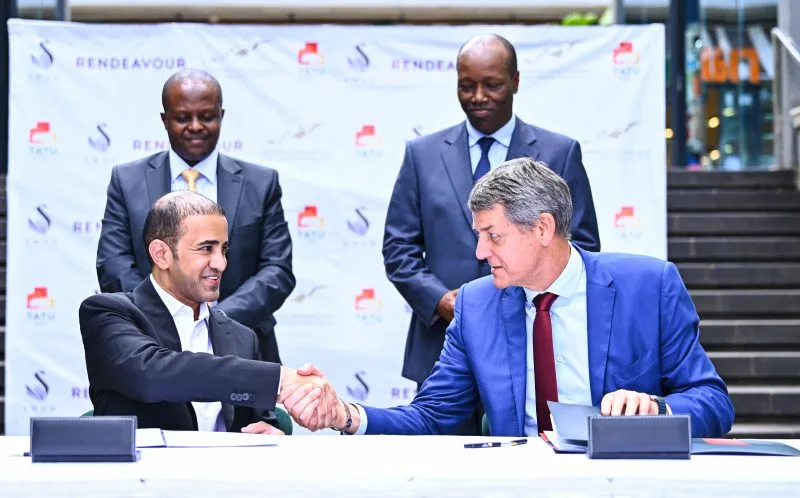
The deal, announced at a formal signing ceremony in Nairobi on July 7, sees Mabani’s subsidiary, Swan Properties, take a 50 percent minus one share stake in Jabali Towers, while Rendeavour — the Canadian developer behind Tatu City — holds onto majority ownership. Present at the signing were Investments, Trade and Industry Cabinet Secretary Lee Kinyanjui, InvestKenya Chief Executive John Mwendwa, Mabani Group Chairman Abdullah AlMalki, and Rendeavour Founder and Chief Executive Stephen Jennings, a gathering that underscored just how seriously both governments are treating this transaction.
Jabali Towers is not a modest undertaking. The development consists of two soaring towers — one rising 25 storeys, the other 36 — sitting within Tatu City’s Special Economic Zone and combining residential apartments, retail outlets and commercial office space across 88,000 square metres of built environment. China Road and Bridge Corporation was appointed as the main contractor just days before this Saudi acquisition was announced, meaning the project now carries both the financial muscle of Gulf capital and the construction clout of one of China’s most prolific infrastructure firms.
The first tower is already more than 80 percent sold.
That figure is not a minor detail. It tells you that Kenyans — and investors watching Kenya — are not waiting on the sidelines. Apartments range from studio to three-bedroom units, with prices starting at Sh10.2 million, positioning Jabali Towers squarely within reach of an aspirational urban middle class that is growing faster than most official projections dare to acknowledge.
Mabani Group framed its entry into the project as a convergence of its construction expertise, its building materials business and its capital reserves, all deployed in service of a development it clearly views as a high-value long-term bet. Rendeavour, for its part, described the partnership as evidence of deepening Saudi investor interest in Kenya — a characterisation that CS Kinyanjui reinforced when he said the investment signals growing confidence in Kenya as a destination for serious foreign money, and that it is expected to tighten economic ties between Nairobi and Riyadh.
Tatu City itself is already home to more than 110 businesses, thousands of residents and multiple schools, with ongoing developments valued at over $3.5 billion — making it Kenya’s first fully operational mixed-use Special Economic Zone and, by any measure, one of the most consequential urban projects on the African continent. The Saudi stake in Jabali Towers is the latest chapter in a story that young Kenyans have every reason to follow closely, because it is being written on land that was, not long ago, dismissed as a pipe dream.