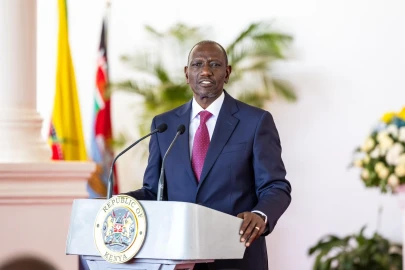
Kenya has confirmed its first Ebola case, and if you think this is just another government press release to scroll past, you need to stop and pay attention — because what happens in the next few weeks will determine whether this stays a single tragedy or becomes something far worse. President Ruto convened the National Security Council Committee, ordered an enhanced national response, and the machinery of the Kenyan state is now moving in ways that directly affect ordinary people, from border communities in Busia to hospital corridors in Nairobi. The deceased patient has been buried under strict public health protocols, but the ripple effects of that one confirmed positive test are still spreading outward, touching families, healthcare workers, and passengers on a commercial flight who may not yet fully grasp what they have been exposed to.
The numbers, when you lay them out honestly, tell a story that is both reassuring and sobering in equal measure. Since the Ebola outbreak began in May 2026, Kenyan authorities screened 652,584 travellers and tested 267 samples across five laboratories — including the National Virology Reference Laboratory, KEMRI Nairobi, KEMRI Kisumu, and two mobile labs deployed at the Busia and Lwakhakha border crossings, precisely the porous entry points that public health experts have long flagged as vulnerabilities. Of those 267 samples, exactly one came back positive. That is the deceased. The government says no additional cases have been detected, and that statement deserves neither blind acceptance nor reflexive dismissal — it deserves scrutiny, because the contact tracing operation now underway is the real test of whether Kenya’s preparedness is genuine or merely performative.
The Human Chain That Determines Everything Now
Eight family members of the deceased are currently under quarantine and monitored daily for symptoms. Twenty-one healthcare workers who treated the patient have also been quarantined — and that number alone should make you feel something, because those are people who showed up to work and did their jobs, and are now isolated from their own families as a consequence of that duty. Beyond the immediate circle, authorities have traced 27 passengers who travelled on the same flight as the deceased when the patient entered Kenya, and public health measures are being implemented for each of them. This is the invisible chain of exposure that epidemiologists lose sleep over, because every link represents a person with a life, a household, a network — and any one of them could become the next confirmation that changes the entire calculus of this outbreak.
The government has trained 4,971 healthcare workers at national and subnational levels on Ebola prevention, detection and management, and designated treatment capacity currently stands at eight beds at Kenyatta National Hospital, 50 at Moi Teaching and Referral Hospital, 49 at the National Police Hospital, and 143 at The Nairobi Hospital, with additional county isolation centres and the explicit commitment to expand capacity if the situation escalates. Whether those beds, those trained workers, and those mobile labs are enough depends entirely on what the next two incubation periods reveal. Rapid response teams have been deployed across the country, and the Ministry of Health is expected to issue additional guidelines for individuals and institutions as monitoring continues. What you should know right now — without waiting for an official pamphlet — is that Ebola spreads through direct contact with the bodily fluids of someone who is symptomatic, which means strict hand hygiene and avoiding contact with anyone showing fever, severe headache, muscle pain, vomiting, diarrhoea or unexplained bleeding are not suggestions. They are the difference between containment and catastrophe.
Kenya has faced pressure points before — from COVID-19 to cholera outbreaks — and the institutional memory of those responses, both their failures and their hard-won lessons, is what now sits between this single confirmed case and a wider emergency. The government’s credibility on this will not be built through press statements alone; it will be built through transparent, real-time communication with the public, through protecting the healthcare workers already in quarantine, and through ensuring that the communities around Busia and Lwakhakha — often the last to receive resources and the first to bear the burden of cross-border health crises — are not left to manage this on their own. Young Kenyans who have watched official narratives crumble before should watch this one closely, hold authorities accountable for every number they publish, and take their own precautions seriously. One case is not a crisis. One case mishandled is how crises begin.