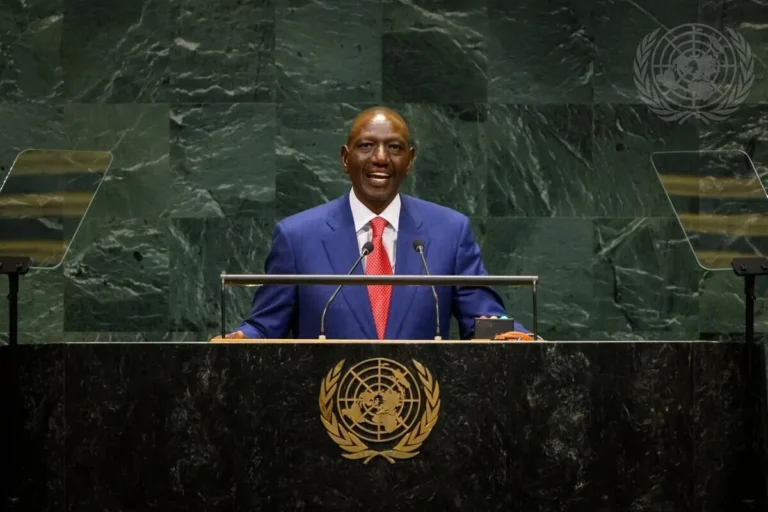

It started, as these things often do, with a tour. President William Ruto kicked off a week-long sweep of the Coast region on Saturday, positioning himself in Taita Taveta to inspect projects and remind Kenyans — loudly — of what he says he has delivered over the past four years. But the inspections were almost beside the point. What Ruto really came to do was fight.
Standing before a crowd that included Governor Andrew Mwadime and Senate Speaker Amason Kingi, Ruto trained his fire squarely on the opposition, and then, with unmistakable intent, on the man he accused of controlling it from the shadows: his predecessor, retired President Uhuru Kenyatta. This was not a casual political jab. This was a deliberate, calculated accusation — and if you are a young Kenyan trying to make sense of who is actually running this country’s political opposition, you need to pay attention.
The Accusation That Changes Everything
Ruto’s claim is blunt: that Uhuru Kenyatta is pulling the strings inside the opposition camp, directing its leaders on what to oppose and what narrative to push. “Sasa huyo mjamaa amewaambia enda pinga SHA kwa sababu ilinishinda, enda pinga housing kwa sababu ilinishinda, enda pinga barabara,” Ruto said, essentially accusing Uhuru of instructing opposition figures to reject the Social Health Authority, affordable housing, and road projects — not on merit, but out of personal rivalry. Think about what that means for a moment. If true, the opposition’s resistance to policies that directly affect your health coverage and your rent is not principled — it is personal. It is one powerful man’s wounded ego dressed up as civic concern.
Ruto did not stop at the accusation. He pre-emptively mocked what he predicted the opposition’s message would be when they arrived in the same region: “Mambo ya masomo hawajui, mambo ya kupanga soko hawajui,” he said, dismissing them as capable only of chanting slogans — “Must Go,” “Kasongo,” “Wantam” — with nothing concrete to offer on education or market development. Whether you agree with Ruto or not, the challenge embedded in that statement is real. What exactly is the opposition’s policy alternative? That question deserves an honest answer.
Coast Leaders Line Up Behind the President
Governor Mwadime did not hold back his enthusiasm, declaring in Swahili that where once the region ate with its eyes — watching development happen elsewhere — it now eats with its teeth and its hands, crediting Ruto directly for the shift. It was vivid, visceral language, and it landed. Cabinet Secretary Salim Mvurya sharpened the political knife further, asking Coast residents a pointed question: if your member of parliament spends all their time insulting the government, when exactly do they sit down with ministers to bring resources home to you? It was the kind of question that cuts through political loyalty fast, especially in a region that has historically felt sidelined by Nairobi’s power games.
The rally of support from Coast leaders around Ruto’s second-term ambitions was not incidental. It was the entire architecture of the visit — a deliberate demonstration that the region’s establishment is aligning with State House, and that opposing Ruto here carries a political cost. For young voters in Taita Taveta, Mombasa, Kilifi and beyond, the message was clear: the president is here, he is building, and those who oppose him are doing so on someone else’s orders.
The Week Ends in Lamu — And That Matters
By the end of the week, Ruto’s Coast tour will culminate in something far larger than any political rally. On Wednesday, he is set to preside over the ground-breaking of the Dangote East Africa refinery plant in Lamu — a project that, if it delivers, could fundamentally reshape Kenya’s energy economy and the livelihoods of thousands along the Coast. That is the bet Ruto is placing: that concrete, visible, large-scale projects will drown out the opposition’s noise, and that Kenyans — especially young, economically anxious Kenyans — will judge him on outcomes rather than on the political theatre swirling around him.
Whether Uhuru is genuinely orchestrating opposition strategy from retirement, or whether Ruto is simply using a familiar name to deflect legitimate criticism, is a question only time and evidence will settle. But here is what you should not do: take either side’s word for it uncritically. Watch what gets built. Watch what gets blocked. Watch who benefits. The truth of Kenyan politics has never lived in speeches — it lives in what happens after the cameras leave.