An Artist Opens His World
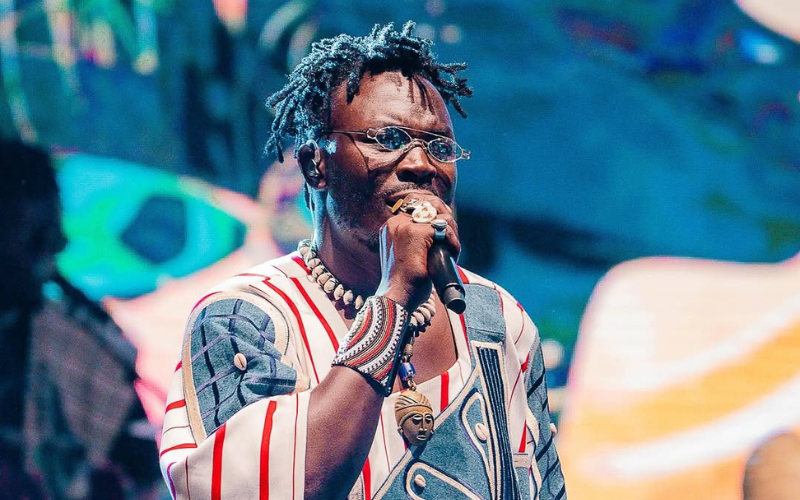
Coster Ojwang’ didn’t just hang paintings on a wall. He cracked open his entire life — his grief, his Luo identity, his Nairobi hustle, his faith, his dead mother — and invited strangers in to look around. The Odyssey of Jalupo, his new solo exhibition, is not a gallery show in the polite, hands-in-pockets sense. It is a reckoning. Forty-one pieces spanning mixed media, collage, charcoal, acrylics, oils and paper, all made between 2020 and now, all pulling from the same deep well of memory, ancestry, land and survival. If you think art is decoration, this exhibition will correct you.
Ojwang’ is many things — musician, fashion figure, cultural commentator — and he has spent years watching those identities compete for oxygen in a creative scene that struggles to hold complexity. This exhibition is his answer to that tension. “Arts, music, culture, and fashion are all fighting for space,” he says. “I want to show them to people, to invite people into my life.” That invitation is not casual. It is deliberate, structured and deeply personal, rooted in a worldview shaped by his grandmother’s voice, his Christian faith and a relationship with his father that runs like a current beneath the work.
Blackjacks, Daisies and the Luo Diaspora
The Blackjacks and Daisies series — nine pieces — anchors much of the exhibition’s emotional logic. Blackjacks, those stubborn little weed-plants that attach themselves to your clothes and travel with you whether you invited them or not, have been a recurring motif in Ojwang’s work since the pandemic hit. For him, they are not weeds. They are biography. “As a Luo man who has been living in Nairobi and in different places in my life and work, blackjacks resemble how they can be transported from one place to another,” he explains. He sees in them the exact texture of migration — the way a person carries culture, memory and identity across geographies without always choosing to.
But Ojwang’ doesn’t stop at metaphor. He reads the blackjack’s life cycle as a spiritual statement. The plant dries itself out, appears to die, and then disperses — beginning again somewhere else. “They dry themselves. It represents the end of their life, which is usually the beginning of a new life.” That is not a passive observation. That is a man who has thought hard about what it means to leave home, to be transplanted, to persist. The daisies in the series work differently — they demand patience, reward attention, and then disappear. “You wait for about a week, and they are dead. That one week is very rewarding.” Beauty as a deadline. Care as a practice that time will eventually end. These are not light ideas dressed up in flowers.
The Women Who Made Him
Resting Matriarch is the piece that makes you stop. It looks at the women in Ojwang’s life — his sister Lundi, his mother, his grandmother — and what they have built in him. He has dressed the central figure in clothing that reads as retro but lands as contemporary, collapsing time the way memory does, the way influence does. He frames her as a symbol of hope and a portrait of the modern woman, but what comes through is something more specific: gratitude, shaped into paint and canvas. His grandmother, a singer, runs through the entire exhibition like a bassline — present in his understanding of music, of storytelling, of what it means to carry culture forward in your own body.
Then there is Hug Me Please. This is the piece that costs something to look at. It depicts Ojwang’ and his mother, drawing from his song Anyango, and it lives inside grief, memory and the specific loneliness of losing a parent before you were old enough to form a complete picture of them. His mother died when he was young. He has one photograph of her. One. “For a few years, I got to cry on Mother’s Day because everywhere on the internet is Happy Mother’s Day, but I only have one picture of my mother, and it is only me who has it.” He remembers her sitting at a kitchen doorstep when he was five years old, while his father attended to a sheep giving birth. That fragment is what he has. He turned it into art because he had no other place to put it.
African Stories, Told Without Permission
What Ojwang’ is doing with this exhibition is not new in the global art conversation, but it is urgent in the Kenyan one. He is insisting that African stories — his Luo lineage, his Nairobi existence, his family’s landscapes — belong in the visual art form, fully rendered, without apology or translation for outside audiences. “I want to tell African stories in the visual art form. There are landscapes of my place, repositories of memory, relationships and people juxtaposed on the land,” he says. The work spans spirituality, ancestry, culture and music not because he is trying to be comprehensive, but because that is what a life actually contains. He is not curating an identity. He is documenting one.
The exhibition is also, explicitly, a beginning. Ojwang’ calls it a precursor — a first public statement of what he intends to do with visual arts as a sustained discipline alongside everything else he carries. He wants audiences to leave knowing the person behind the creative disciplines, not just the output. “I want people to learn from me and appreciate art.” That sentence sounds simple. It isn’t. It is a young Kenyan artist staking a claim on a space that has not always made room for voices like his, betting that his story — the blackjacks, the daisies, the one photograph of his mother — is exactly the kind of story that deserves a wall.