
A Body in Athi River, a Husband Gone Missing
It was May 9, 2024, when the body of Sheila Odoyo was discovered inside her house in Athi River. She was dead. Her husband was nowhere to be found. That disappearance was not a coincidence — it was a calculated escape, and it would take Kenyan detectives two full years, cross-border intelligence, and a joint operation with Tanzanian law enforcement to close the net around the man they believe killed her.
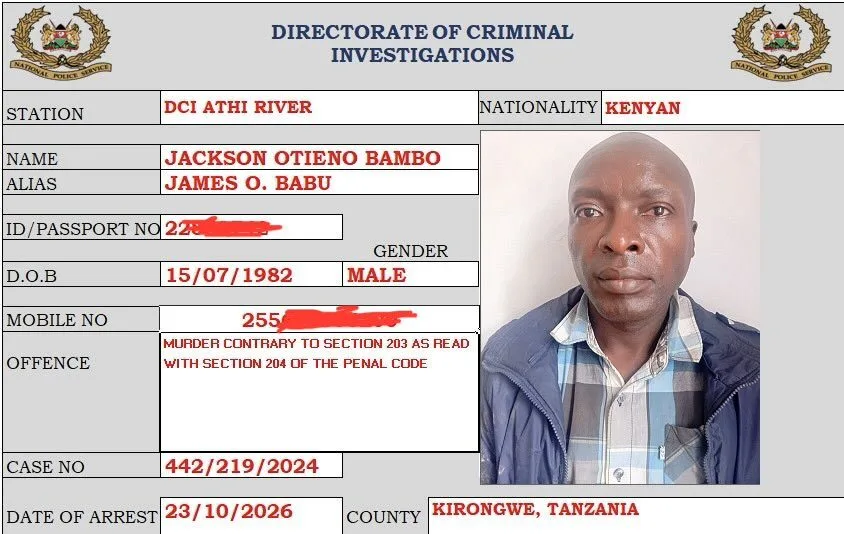
The suspect, now identified as Jackson Otieno Bambo, did not just vanish into thin air. He ran. He crossed an international border, assumed a new identity, and built himself a quiet, almost comfortable life on the other side. He was not hiding in a ditch. He was running a club in Kirongwe, Shirati District, Tanzania — roughly 70 kilometres from the Muhuru border point — while Sheila’s family waited for justice back home.
The Alias, the Club, and the Fake ID
Bambo was not operating under his own name. He had reinvented himself as James Babu Olang, a name that appeared on a Tanzanian national identity card found in his possession at the time of his arrest. That card is now part of an active investigation. The audacity of it is almost breathtaking — a man wanted for murder, living openly enough to run a business, banking on the assumption that no one would look that far, or that hard.
But detectives from Athi River did look. They pursued multiple leads across a two-year investigation that refused to go cold. When intelligence finally placed Bambo across the border in Tanzania, the Directorate of Criminal Investigations (DCI) moved fast. Detectives from Athi River linked up with their counterparts in Nyatike and coordinated directly with Tanzanian law enforcement officers to mount a joint operation. The operation worked. Bambo was arrested in Kirongwe without, as far as we know, any dramatic confrontation — just the quiet, inevitable weight of accountability catching up.
The Arrest and What Comes Next
After his arrest, Bambo was processed at Nyatike Police Station before being transferred to Athi River Police Station, where he is currently being held in custody pending arraignment. The DCI has confirmed that he is expected to face a murder charge in connection with Sheila Odoyo’s death. Two years after her body was found, the man her family says is responsible for her killing is finally on Kenyan soil, in a police cell, facing the full weight of the law.
The DCI reaffirmed its commitment to cross-border cooperation in pursuing suspects accused of serious crimes — and this case proves that commitment is not just rhetoric. It is easy to be cynical about Kenyan institutions. Many of us have every reason to be. But a two-year manhunt that crosses an international border, cracks a false identity, and brings a suspect back to face trial is not nothing. It is exactly what accountability is supposed to look like.
Why This Case Matters Beyond the Headlines
Femicide is not a new conversation in Kenya. Women are killed by intimate partners at a rate that should horrify every one of us, and too often those cases dissolve into silence — no arrests, no charges, no justice, just grief. Sheila Odoyo’s case is different, not because her death was more tragic than others, but because the system, this time, refused to let the suspect simply disappear. That matters. It sends a message to every man who thinks he can kill a woman and run: the border is not a finish line.
Jackson Otieno Bambo is presumed innocent until a court of law says otherwise. That is how the law works, and it should. But the evidence being assembled — the false identity, the flight across the border, the two years of evasion — will tell its own story in court. Sheila Odoyo deserved better than what happened to her on May 9, 2024. Her family deserves to see this through to the end. And Kenya deserves to know that when a woman is murdered, the state will not simply move on.