Picture this: it’s late 2026, and your WhatsApp groups are already on fire. Politicians are making their moves, coalitions are forming, and the noise is deafening. But strip away the drama, the rallies, the slogans — and ask yourself one honest question. What exactly are you voting for?
Kenya has been here before. Too many times. And the pattern is exhausting.
In 2002, the country united behind “Moi Must Go” — a slogan that captured a nation’s rage after 24 years of KANU’s suffocating grip on power. It worked. Daniel arap Moi was gone. But the National Rainbow Coalition that swept into State House quickly fractured, because removing a president and actually governing a country are two completely different propositions. The campaign had been built on rejection, not on a vision. And Kenyans paid the price for that gap.
2007 repeated the cycle with even bloodier consequences. The Orange Democratic Movement generated genuine mass excitement — Raila Odinga’s coalition was broad, electric, and full of promise. Then came the disputed results, the violence, the power-sharing deal that left deep wounds across communities. Again, the political energy had been channelled into personalities and alliances, not into a concrete programme for governing.
2013 and 2017 brought their own versions of the same game. Uhuru Kenyatta and William Ruto weaponised the ICC cases into a sovereignty narrative. Jubilee ran on “Tano Tena.” The opposition ran against authoritarianism. Fear and personality — always fear and personality — drove the conversation, while the actual business of improving Kenyan lives remained secondary.
2022 felt briefly different. Ruto’s “Hustler Nation” pitch spoke directly to millions of Kenyans who had watched the political elite trade power among themselves for decades while ordinary people hustled for survival. For once, there was a message that felt personal — that told voters what was specifically in it for them. Whether the delivery matched the promise is a separate, damning conversation.
Now we are being handed the next slogan: “Ruto Must Go.”
Let’s be clear — there is nothing wrong with wanting to remove an incumbent. That is democracy working exactly as it should. But “Ruto Must Go” cannot be the entire political programme. It is not a healthcare policy. It is not a jobs plan. It will not bring down the cost of unga or school fees or fuel. Kenyans who have watched their purchasing power collapse under the weight of taxes and inflation deserve more than a catchy exit demand.
The opposition must answer the harder questions: What comes after? Which policies will they introduce? How will they create jobs? What will change at the hospital, in the classroom, on the farm? Asking Kenyans to reject Ruto without offering something credibly better is not a political programme — it is a power grab dressed up as liberation.
On the other side, Ruto’s emerging 2027 message — “Usawa ni Sawa” — centres on equity, equal opportunity and fairer distribution of development. The idea deserves a serious national conversation, not dismissal. Kenya’s devolution architecture was built precisely to correct historical imbalances, and the question of whether national development is becoming more evenly distributed is a legitimate and urgent one. But slogans are not results. “Usawa ni Sawa” must be tested against what has actually been built, who has benefited, and where the money has gone.
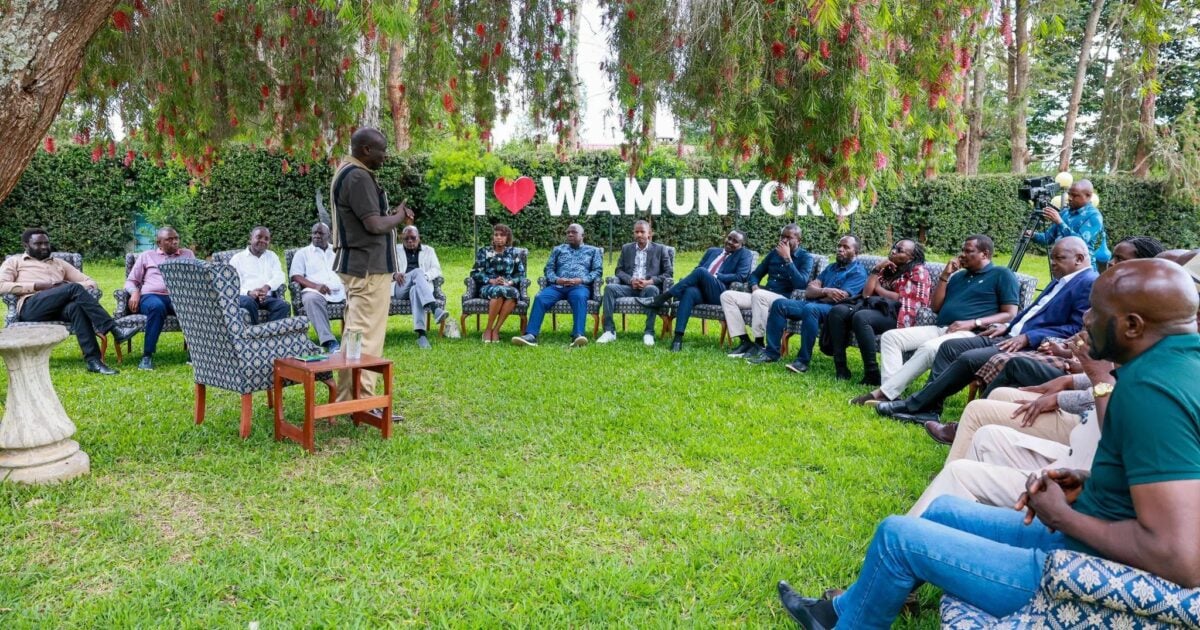
Then there is the theatre around Rigathi Gachagua and the politics of Mt Kenya. When any community is presented as a single, monolithic political bloc behind one individual, smart voters should push back hard. Mt Kenya is not one voice. No region is. Kalonzo Musyoka’s decision to align with Gachagua — even as other leaders from the region kept their distance — raises a question that cuts to the heart of Kenyan politics: was that loyalty to a community, to a principle, or simply to a political calculation? Voters, not strategists, must answer that.
Here is what 2027 should actually be about. Two questions, and two questions only: What will make a real, tangible difference in the lives of ordinary Kenyans — and which political programme offers the most credible, honest path to delivering it? Everything else — the alliances, the slogans, the regional arithmetic, the personality cults — is noise designed to distract you from demanding real answers.
Kenya is bigger than the ambitions of its political class. Communities should not be asked to surrender their choices to individual leaders who claim to speak for entire regions. Voters should not be persuaded that one politician’s interests automatically represent theirs.
The real test of 2027 is not whether Kenyans can be mobilised to remove someone. History has shown we are very good at that. The test is whether Kenyans will finally demand to know not just who should leave — but who should replace them, why, and what that change will actually mean for the person waking up at 5am to catch a matatu to work.
That is the election worth fighting for.